

Showcases and tournaments — get seen by the right coaches
More recruiting decisions are made here than anywhere else — and most athletes have no idea how to use them. A showcase isn't a guaranteed evaluation. It's an opportunity for one.
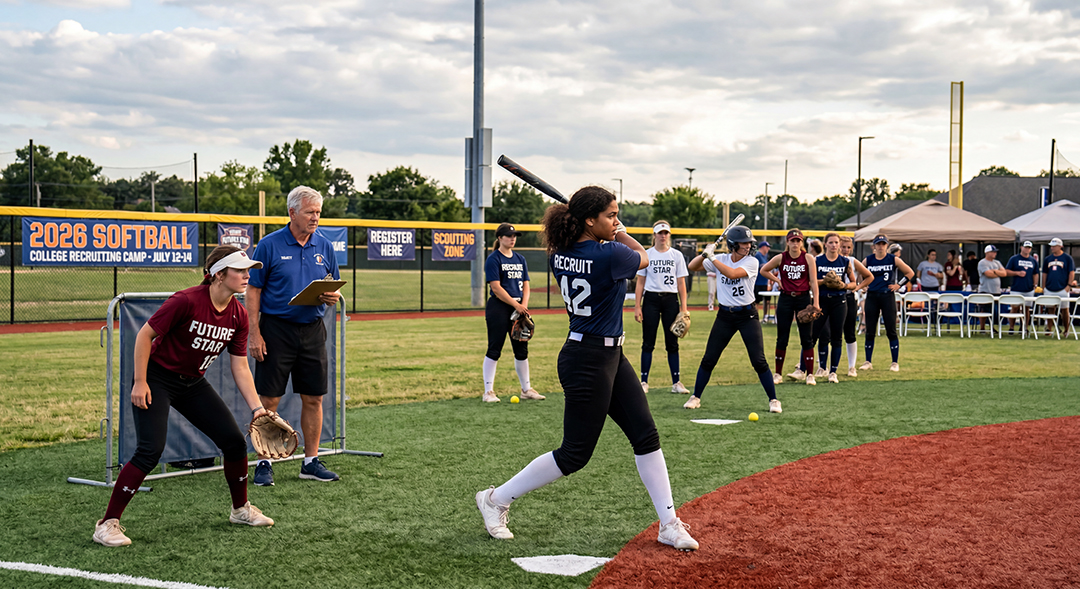
An opportunity becomes an evaluation only when all four are true
The right coaches are actually present.
They can find you in a field of hundreds.
They see you compete in a moment worth watching.
Something happens afterwards that moves it forward.
Every one of those is something you can influence deliberately. Most families leave three of them to chance.
The showcase landscape
Recruiting value depends on the division you're targeting, your grad year, your region, and which specific coaches attend — not the marketing or the registration fee.
PGF Nationals, USSSA National Championship, Top Gun Summer Nationals — where the biggest staffs attend in meaningful numbers.
Density is the problem. With hundreds of teams across dozens of fields, a coach is working a schedule of names. Being there is necessary, not sufficient.
Frequently more productive for these levels, because the coach-to-athlete ratio is friendlier.
The same coach has far more time to watch the athletes they're specifically targeting than they would at a national event.
Some programs run their own events with coaches invited to evaluate. Quality varies enormously.
Ask which specific coaches attend, at what level, and whether they're evaluating your grad year.
Events not billed as showcases still produce a significant share of evaluations — especially for younger grad years.
The label matters less than whether the right coaches are watching.
Five things that decide whether an event is worth it
The single most important fact: which staffs are confirmed to attend. Use the event's coach registration list, ask the organisers, ask your target coaches directly, and use your travel director's relationships.
A showcase with no coaches from your list is a development experience, not a recruiting opportunity.
Coaches evaluating top D1 prospects are at the national circuits. For D2 and NAIA, a strong regional may produce more direct contact than a national event where those coaches compete for evaluation time. D3 recruits more regionally still.
A coach who watches you struggle against competition well above your level has formed an evaluation that doesn't serve you. The right event is one where you can compete successfully against opponents who reflect or slightly exceed your ability.
If your team is at a regional drawing none of your target coaches and a showcase two hours away draws three, the right call may be a separate weekend. Travel ball friendships are real — they shouldn't drive a junior's showcase calendar.
Fees, travel, hotel, missed practice. An event with confirmed target coaches evaluating your class is justified; one with none is speculative — and speculative events crowd out high-value ones.
Setting up the evaluation
The most common mistake is treating a showcase as self-contained — arrive, compete, leave, then wonder why nobody reached out. What got missed is everything that should have happened before you arrived.
This moves your name from the general pool onto a coach's specific agenda for that weekend. Four to six sentences, assuming the relationship and providing logistics — no re-introduction of your stats, they have those.
Field assignments and game times for each day. A consistent jersey number — not a borrowed one that differs from what you sent. And the exact team name including any suffix, because coaches confuse similar names constantly.
If anything changes after your email, send a two-line update.
Name, grad year, position, team, jersey number, profile link. A coach walking the fields can note it without interrupting anyone.
Ten minutes of work, and occasionally the difference between being found and being walked past.
Which attending coaches have an active relationship? Which have shown interest but never seen you in person? Which are targets who've never heard from you? Each of those calls for different behaviour at the event.
"Coach [Last Name] — I wanted to let you know I'll be competing at [Event Name] in [City] from [Dates] with [Team Name]. We're currently scheduled to play on [Field] at [times on specific days]. I'd love the opportunity for you to see me compete if your schedule allows. My jersey number is [number]."
Six things to get right on the weekend
Because someone might be. Schedules shift — a coach arrives early and catches the end of the previous game, or pivots after noticing a warm-up. The evaluation can start at any moment.
When a target coach is known to be watching: a short acknowledgment during a break, never during active play. "Coach [Name] — good to see you. Glad you could make it." Then straight back to competing.
Evaluators see the whole at-bat, the body language between pitches, the error and what happens immediately after. Holding effort and composure through a 12–2 game in July heat is itself filed in the evaluation.
Coaches write down numbers, but they remember athletes who became specific people — how you carry yourself between innings, how you are with teammates. You don't need to perform character. You need to compete in a way that's recognisably you.
Coaches watch the ball, so visibility isn't even across positions. A corner outfielder gets at-bats but limited defensive looks — which makes the at-bats carry more weight and every chance matter more.
It begins in the bullpen, not at the first pitch. Coaches watch warm-ups to assess mechanics, velocity, pitch mix and demeanour before a batter steps in. Warm up as though you're being evaluated, because you are.
Follow up while the memory is fresh
Most athletes compete well and then leave the value uncollected. The follow-up goes out within 24 to 48 hours — not a week later when the weekend has blurred. Every target-program coach who was present gets one, whether or not you spoke to them.
"Coach [Last Name] — thank you for making time to watch us compete this weekend. We finished [result] and I was [brief performance summary]. [School Name] remains at the top of my list and I'd love to connect by phone this week if your schedule allows."
"Coach [Last Name] — I hope you had a chance to see [Team Name] at [Event Name] this weekend. We went [result] and I finished [brief summary]. If you were able to watch, I hope it was useful for your evaluation. I remain very interested in [School Name] and would welcome a conversation at your convenience."
Brief intro — name, grad year, position, team, level. Event performance with context. Profile link. Clear interest with one specific detail showing real research. A short ask for a next step.
- Exaggerating the performance. Coaches talk to each other and attend the same events. Overclaiming creates a credibility problem that's very hard to recover from.
- Sending the same email to everyone. The note to a coach who watched three games is not the note to one who may not have been there.
- Waiting more than 48 hours. By 72 the event is filed; by a week the impressions have faded. The window closes faster than most families expect.
Build the calendar in November
Ahead of registration deadlines, and with enough lead time to research which events actually draw the coaches you need.
Development
One or two events at the level that fits your current program. Build competitive exposure, not premature recruiting pressure.
Highest priority
Two to three events minimum where target coaches are confirmed to be evaluating. Quality and targeting matter far more than volume here.
Still live
Coaches at every level keep filling roster gaps from the senior class. An uncommitted senior at the right event is a fully viable recruit.
- Will coaches from target programs be there in meaningful numbers?
- Is the competition level appropriate for where you are right now?
- Does the timing align with the recruiting calendar for your grad year and target division?
- Does the investment justify the expected outcome?
The details that matter
The events you attend are largely determined by your club. When evaluating programs, the showcases they attend and the coach relationships they hold are legitimate factors alongside coaching quality and competitive level.
A .450 average at a Gold-level qualifier reads differently from .450 at a local invitational. Coaches know the context of every major event — so always include the event name and the level.
A parent with a phone, a teammate filming from the dugout, or a service if one's offered. The highlight video that produces conversations is almost always built from showcase and tournament footage. Building the video →
College coaches phone travel coaches to ask about character, coachability, academics and what kind of teammate you are. That relationship is being evaluated every time you compete — not only at designated showcases. The calls you never hear about →
It isn't a lottery. It's partially outside your control.
Which is a meaningfully different thing, and the difference is where all the leverage lives.
- Which events you attend — and whether the right coaches are there
- The pre-event email that puts your name on their agenda
- Your jersey number and how findable you are
- The quality and consistency of how you compete
- The follow-up within 48 hours
- Who shows up, and which fields they watch
- How their schedule aligns with your games
- What positional needs they arrive with
- Which other athletes caught their attention first
Families who work the controllable side well generate conversations at a far higher rate than families who show up and hope.
Choose the right events. Prepare the coaches before you arrive. Compete fully and consistently. Follow up specifically while the memory is fresh.
The showcase is not a lottery. It's a system. Work the system.
Next steps
ATHLETESGOING2COLLEGE
STAND OUT | GET NOTICED | GET RECRUITED
The step-by-step college softball recruiting system — six stops from learning how recruiting works to signing with a program that fits. Your athlete runs it, under their own name.
Start the Blueprint — $199/yr →$24.99/month or $199/year · No contracts · Cancel anytime
Recruiting rules change and vary by division. Always confirm current rules with the governing body: NCAA.org · NAIA.org · NJCAA.org