

College camps — choose, impress, follow up
A college camp isn't a vacation. It's one of the few places in recruiting where you control the evaluation environment completely.
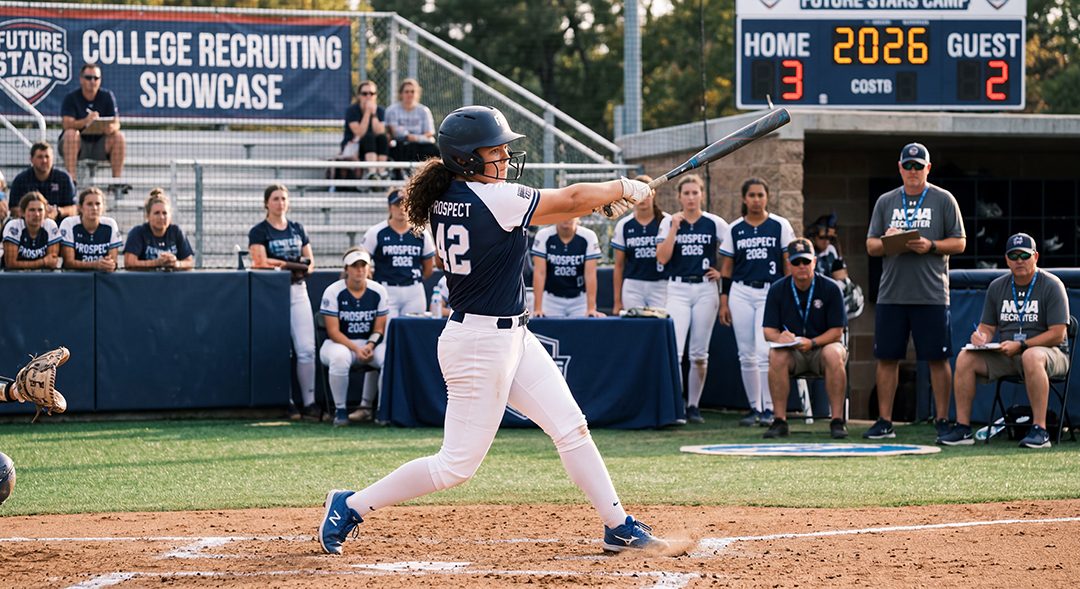
At a showcase, a coach watches from a distance, evaluates quickly, and moves on. At a camp their program is running, they're watching you up close, in their facility, for hours.
How you receive instruction and what you do with it. How you interact with current players and other recruits. What you do when a drill isn't going well, and what you do when it is.
Athletes who understand that use camps strategically. Most families use them reactively.
Not all camp invitations mean the same thing
This is where families lose the most money in recruiting, and it turns on a single distinction.
Arrives from a camp address. Mentions the camp, the dates and the price. Says nothing about you.
Camps are revenue, and filling them is a business function. This isn't interest — it's marketing with your name merged into it.
Not worthless. Just not a signal, and never the basis for a summer.
Comes from a specific coach, in a relationship that already exists, and names your position, your class, or something they saw.
The strongest version says outright that they want to evaluate you there. That is genuinely one of the strongest signals short of an offer — and declining it without explanation walks away from something that may not come twice.
If you can't attend, say so and say why. Silence reads as disinterest.
The test is the same one that sorts every other message: could this exact invitation have been sent to two hundred other athletes? Reading interest properly →
Four kinds of camp
Built for recruits, run by the staff, on campus, used explicitly to evaluate. When a coach personally invites you, this is usually what they mean.
They're assessing ability against your film, coachability under instruction, how you handle success and failure, and whether the in-person impression matches the digital one.
Whole travel or high school teams in a tournament format. Staff may observe, but they're watching games rather than making individual assessments.
Worth attending at a serious target when the staff is known to be watching. Not equivalent to a prospect evaluation.
Focused on development, and frequently a revenue activity. Coaches are teaching, not recruiting.
At a program that hasn't shown interest it can introduce you in person — but it isn't an evaluation invitation.
Several programs evaluating at one event, usually run by a third party. Engagement varies enormously — some coaches genuinely evaluating, some browsing.
Research which specific coaches will be there before registering, not just which schools are listed.
Five questions for every camp
Every camp should answer yes to at least one. Yes to several makes it a priority. Yes to none means the money is better spent elsewhere.
The productive camps are where a relationship exists or could realistically develop. Camps chosen for a convenient location, a low price, or because a teammate is going rarely produce anything. Your target list →
A personal invitation is close to the strongest signal there is. A mass email isn't one at all — and the difference decides whether this camp is a priority or a maybe.
Verify who's running it. The head coach and recruiting coordinator running drills is a fundamentally different event from graduate assistants instructing while the head coach appears occasionally.
A D1 camp in freshman or sophomore year has developmental value but rarely produces an outcome before that class is being decided. The same camp junior year — when they're filling it — is a different opportunity entirely.
Fees, travel, hotel and missed practice add up fast. A camp at a program actively recruiting your class is justified; one with no demonstrated interest is speculative — and speculative camps crowd out high-value ones.
If you're travelling to a camp at a target school, you're already on that campus. Build in half a day and take the unofficial visit while you're there — the travel is already paid for. Making a visit count →
Preparation that changes the outcome
At a program actively recruiting you: three sentences, seven to ten days out. Confirm attendance, say you're looking forward to it, remind them who you are and what you play. So they arrive with your name in mind rather than discovering it at registration.
The schedule, which coaches run which sessions, how evaluation works. Knowing it in advance frees your attention for competing instead of navigating logistics.
A camp is a competitive evaluation, not a relaxed training day. Not exhausted from a tournament the day before, not having skipped a meal. More sleep the week before, normal training, no new physical stressors.
Clean, position-appropriate gear in team or neutral colours — not another college's apparel, which coaches absolutely notice. Know your number before you arrive; coaches write down numbers, not names. If they're assigned, get there early.
Seven things that get noticed
The drills are the evaluation — not just the live-game portion. A coach who sees you fix a flaw between rep one and rep three has watched coachability happen in front of them.
Eye contact, a verbal acknowledgment, an attempt on the very next rep. Noted negatively: a glazed look, a nod followed by the same thing again, explaining why you were already right, or looking away while they're still talking.
Coaches see the difference between competing hard because that's how you're built and performing because you badly want to be evaluated well. Actual effort, not a performance of effort.
At a break — never mid-drill. Name, grad year, position, and that you've been looking forward to it. It puts a face and a voice with the number and shows the social confidence coaches are assessing anyway.
In downtime, ask real questions about the program and daily life. The answers help you evaluate fit — and the asking shows something no drill can surface.
Something will go wrong — a strikeout, a throwing error, a velocity reading you didn't want. Reset and compete on the next one. The athlete who manages that at seventeen is the one who manages it at twenty-one with a season on the line.
Near the end, not mid-evaluation. Not "how did I do?" — that invites something vague. Ask: "Is there anything you saw today I should be working on?" or "Is there anything else you need from me to continue the evaluation?"
The follow-up that turns a good day into an opportunity
One of the highest-leverage emails in recruiting, and it goes out the evening of or the next morning. It isn't a thank-you note — it's a recruiting communication that happens to begin with gratitude.
- Something specific — a drill that challenged you, instruction you'll work on, a conversation with a player. Generic gratitude is invisible.
- What you're taking away — what you learned, and what the camp confirmed about the program.
- An honest statement of where they stand with you. If it's a top priority, say so plainly.
- A forward-looking line — confirm a next step, or propose one. Don't let the camp be an endpoint.
- A summary of the whole day. Three to five paragraphs.
- Generic praise for the campus or facilities that would fit any school — cut anything not specific to this program.
- A request for an offer. They're processing many evaluations; asking within 24 hours misreads the timeline badly.
Template 5 is written for this exact email →
Warm, specific feedback and "I'll be in touch." Move into the active phase — respond fast, stay in contact every four to six weeks, be ready for a visit.
Professional but not specifically enthusiastic, no clear next step. Continue the normal cadence and include them after future events. The camp may have planted something.
Staff present but not engaged with you specifically. Reassess the program's priority. It doesn't close the door — it calibrates the expectation.
Build the calendar from the list, not the other way round
Most families register reactively, fitting camps around the travel schedule. That's busy, not strategic. Start with your school list and work backwards.
Not all do — some rely entirely on showcase evaluation. Your travel coach usually knows which. Ask them →
Most evaluation camps run in summer, some in spring and autumn. Find the ones that fit around travel ball and school.
Personally invited = highest priority. Developing relationship, no invitation = worth a direct inquiry. No relationship = lower priority unless the fit is exceptional.
A brief email to the recruiting coach about dates is entirely appropriate — and coaches recruiting your class sometimes answer with a direct invitation.
Then fit everything else around them. Don't let a low-potential instructional camp block a prospect evaluation at a target school.
A camp does its job. It doesn't do the whole job.
Not every camp produces an offer, and an invitation isn't a commitment — coaches who invite you are evaluating, not deciding.
What a strong day actually does: it gives the in-person confirmation that lets a program continue with more confidence. Which puts you closer to the visit, which puts you closer to the offer. It's one step in a sequence.
Athletes who get frustrated when a camp doesn't immediately produce an offer are expecting it to do everything. Do the camp well. Follow up immediately. Keep the process moving.
Next steps
ATHLETESGOING2COLLEGE
STAND OUT | GET NOTICED | GET RECRUITED
The step-by-step college softball recruiting system — six stops from learning how recruiting works to signing with a program that fits. Your athlete runs it, under their own name.
Start the Blueprint — $199/yr →$24.99/month or $199/year · No contracts · Cancel anytime
Recruiting rules change and vary by division. Always confirm current rules with the governing body: NCAA.org · NAIA.org · NJCAA.org