

Your first call with a coach
A coach who picks up the phone has already decided you're worth their time. The call isn't an audition for whether they're interested — it's an audition for whether you're ready.
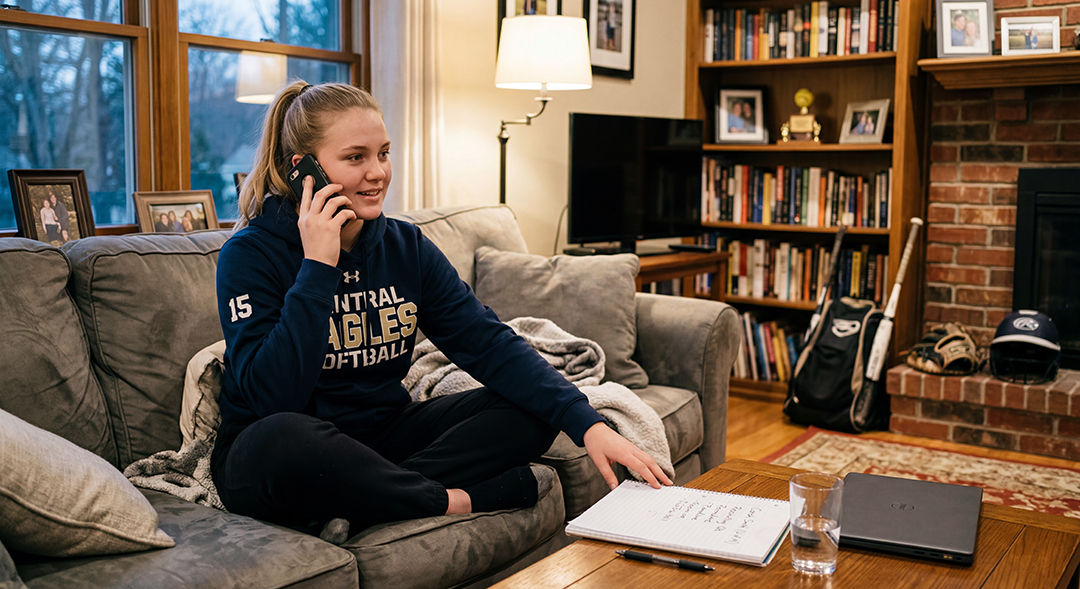
Everything before this — the emails, the film, the showcase, the profile — got you to this moment. What happens on the call decides whether it deepens into a visit and eventually an offer, or fades into a polite exchange that goes nowhere.
The athletes who handle these well aren't the ones with the most polish or the fewest nerves. They're the ones who prepared for this program specifically, knew what they wanted to say, asked questions that showed real engagement, and left a coach with a clear sense of who they'd been talking to. All of which is entirely within your control.
Preparation is the whole game
An athlete who prepared for a conversation with a specific coach sounds completely different from one figuring it out live. Coaches notice within a minute.
You should be able to answer these without pausing.
- What conference do they compete in? Not just the division — the conference, and what it means for competition and travel.
- Who is the head coach, and what's their background? Where they played and coached, what they're known for. Familiarity registers instantly — so does not knowing their name.
- What happened to the program this season? A tournament result, a transfer, a class they signed. Twenty minutes on the site and socials turns a questionnaire into a conversation.
- What does the roster look like at your position? Who's graduating, who's starting — so you can speak about fit rather than guess at it. Reading a roster →
- What does the school offer academically that matters to you? If you have an intended major, know whether it's offered and what it's known for. "I'm not sure yet" isn't memorable.
The broadest question and the one athletes are least ready for. Prepare a thirty-second version — name, grad year, position, school, and one or two specific real things about you. Not the whole recruiting email. Just have an answer.
Asked to find out whether you've thought about fit or are chasing prestige. A specific answer — smaller campus, strong in your field, development-focused, an accountable culture — tells them whether this is likely a match.
Have the GPA and any scores ready. Answering confidently and accurately signals academics aren't a liability in the evaluation.
The honest answer is the right one. You needn't name every program, but acknowledging conversations at a similar level is natural — it signals other coaches see value. Don't imply nobody else is interested if that isn't true.
An athletic and character question at once. Prepare something specific and genuine — not a list of adjectives, but a real description of what you contribute on and off the field.
Every effective call ends with a clear next step — a campus visit, being added to the list for your class, a second call after your next showcase, a timeline for their evaluation.
Going in knowing what a successful outcome looks like — and being ready to ask for it if the door opens — is the difference between a call that moves the relationship and one that ends warmly and goes nowhere.
Logistics
Not a car, a hallway, or a busy house. A quiet room, sitting down, with everyone around you told you're on an important call.
A printed page on the table — program facts, prepared answers, your questions. A support, not a script being shuffled audibly into the phone.
Write down names, dates, timelines, roster details. Coaches say things casually that become critical context in the follow-up.
So you answer knowing who's calling — and don't send a recruiting call to voicemail because it came from an unknown number.
If they ask — and they frequently do — you can give it instantly rather than searching while a coach waits.
Not the house — the room. A parent present is one anxious moment away from interjecting, and their nerves become yours. The call belongs to you.
How to handle the conversation
They'll open, introduce themselves, acknowledge your earlier contact. Your job is to be warm, present and ready to engage — not to launch into a monologue.
"Thank you so much for calling, Coach. I've been really looking forward to talking with you." Brief, genuine, then follow their lead.
Reference what they just said rather than rolling to your next prepared answer as though they hadn't spoken. Ask follow-ups that build on what they shared.
And tolerate silence. A brief pause is the rhythm of a thoughtful conversation, not a cue to panic and fill it.
Be specific. ".430 against Gold-level pitching this spring" beats ".430 this season."
Be honest about what you're working on — naming a development area and how you're addressing it shows coachability better than anything else you could say.
And talk about your game, not your feelings about it. "Contact hitter, rarely strike out, .510 on-base" beats "I'm a hard worker."
If you researched it genuinely, "why us specifically?" answers itself. If you didn't, the pause before the answer tells a coach exactly what kind of interest this is.
And if you don't know enough yet, say so and turn it into a real question. That works. Manufacturing enthusiasm doesn't.
Questions to ask the coach
The questions you ask say as much about you as your answers. Prepare five to seven — you won't ask them all, but you won't scramble when they say "any questions for me?"
- "You recently graduated a [position] — how are you thinking about that spot in the [year] class?"
- "What does off-season development look like for [pitchers / position players] at your level?"
- "What does a typical in-season week look like — practice, film, conditioning, academic support?"
- "How would you describe the team culture, and what kind of athlete thrives here?"
- "What's the staff–player relationship like for individual development feedback?"
- "I'm interested in [major] — how do athletes in that program manage conference-season travel?"
- "What academic support exists specifically for athletes?"
- "What's the four-year graduation rate for athletes in your program?" — a question most recruits never think to ask, and the answer tells you a lot.
- "What does your evaluation timeline look like for the [year] class?"
- "Is there anything you need from me — film, a questionnaire, updated stats — to help your evaluation?"
- "Would there be an opportunity to visit campus, officially or unofficially, this season?"
"What scholarship money is available?" — appropriate once a genuine relationship exists. On a first call it can read as finances outweighing fit.
"Am I on your offer list?" — the first call is the beginning of the evaluation, not the moment to ask its outcome.
Reading the call
Neither list is a guarantee. Both are useful for working out where to invest your energy next.
- They talk specifically about how you fit their roster needs — "we're really looking at your position in [year]"
- They ask whether and when a visit might work
- They name a specific next step — "I'll be at PGF in July and want to see you pitch"
- They ask about other schools and where they stand
- Warm but vague — general interest, no specific detail about fit
- No next step; it ends with "we'll stay in touch" and nothing more
- They hadn't watched your film before the call
- No questions about your availability for a visit
Handling the nerves
Nerves are normal and they mean you care, which is appropriate. Here's what actually helps.
Research done, answers ready, questions written. That's a source of confidence no amount of reassurance can replicate — and the nerves shrink once it's real.
Run through your answers conversationally, to a wall if necessary. The voice that comes out is warmer than one emerging cold from a silent room.
Because they're interested. This is the continuation of a developing relationship, not a cold audition.
A one-second breath is invisible from the other end — and what fills it beats a rushed answer.
"I don't know yet, but I'll find out and get back to you" beats an invented answer every time. Coaches trust intellectual honesty more, not less.
After the call
Immediately — not an hour later. What they said, what they asked, roster needs, timelines, next steps, anything about their style or the culture. These notes become the foundation of every later conversation.
Not optional. A genuine acknowledgment, a response to the most important thing they said, confirmation of any next step, continued interest. Reference something specific — that's what separates it from the dozens of other post-call emails. Templates →
Status, notes, follow-up date — the same day, while the details are current. Why it decides outcomes →
The call belongs to you; the debrief is where a family processes it together. How did it feel? What was signalled? What should you research before the next one?
This is a moment for parents to ask questions rather than offer an assessment — your read of the call is the one that matters most.
You may speak with an assistant or a recruiting coordinator first. That's standard practice, not reduced interest. At plenty of programs the assistant is the primary recruiter for a position or a class, and that relationship matters as much as the head coach's.
Treat every call with the same preparation — and at some point, ask who your primary recruiting contact will be.
A call is a conversation, not a performance.
The biggest mistake athletes make is treating it as something to get through without error, rather than two people working out whether a four-year relationship makes sense.
A coach who hangs up and says "she had good answers" is less likely to extend an offer than one who says "I really enjoyed talking to her — she asked smart questions, was honest about what she's working on, and seemed genuinely interested in what we're building."
The first describes a performance. The second describes a person. Be the person.
Next steps
ATHLETESGOING2COLLEGE
STAND OUT | GET NOTICED | GET RECRUITED
The step-by-step college softball recruiting system — six stops from learning how recruiting works to signing with a program that fits. Your athlete runs it, under their own name.
Start the Blueprint — $199/yr →$24.99/month or $199/year · No contracts · Cancel anytime
Recruiting rules change and vary by division. Always confirm current rules with the governing body: NCAA.org · NAIA.org · NJCAA.org