

The recruiting timeline and the rules behind it
Recruiting runs on two separate clocks. One is yours and it never stops. The other belongs to college coaches and it's governed by NCAA rules that change by division, by grade, and by the week of the year.
Confusing the two is the single most expensive mistake families make — because it produces waiting. This page covers both: what you can do at every stage, and what coaches are legally allowed to do back.
So the goal isn't to wait for the gate to open. It's to already be in the inbox when it does.
The four periods, and what each one allows
Division I and Division II run on a published calendar that divides the year into four kinds of window. The differences are about in-person contact — none of them stop a coach from emailing or calling once your contact date has passed, and none of them stop you from reaching out at any time.
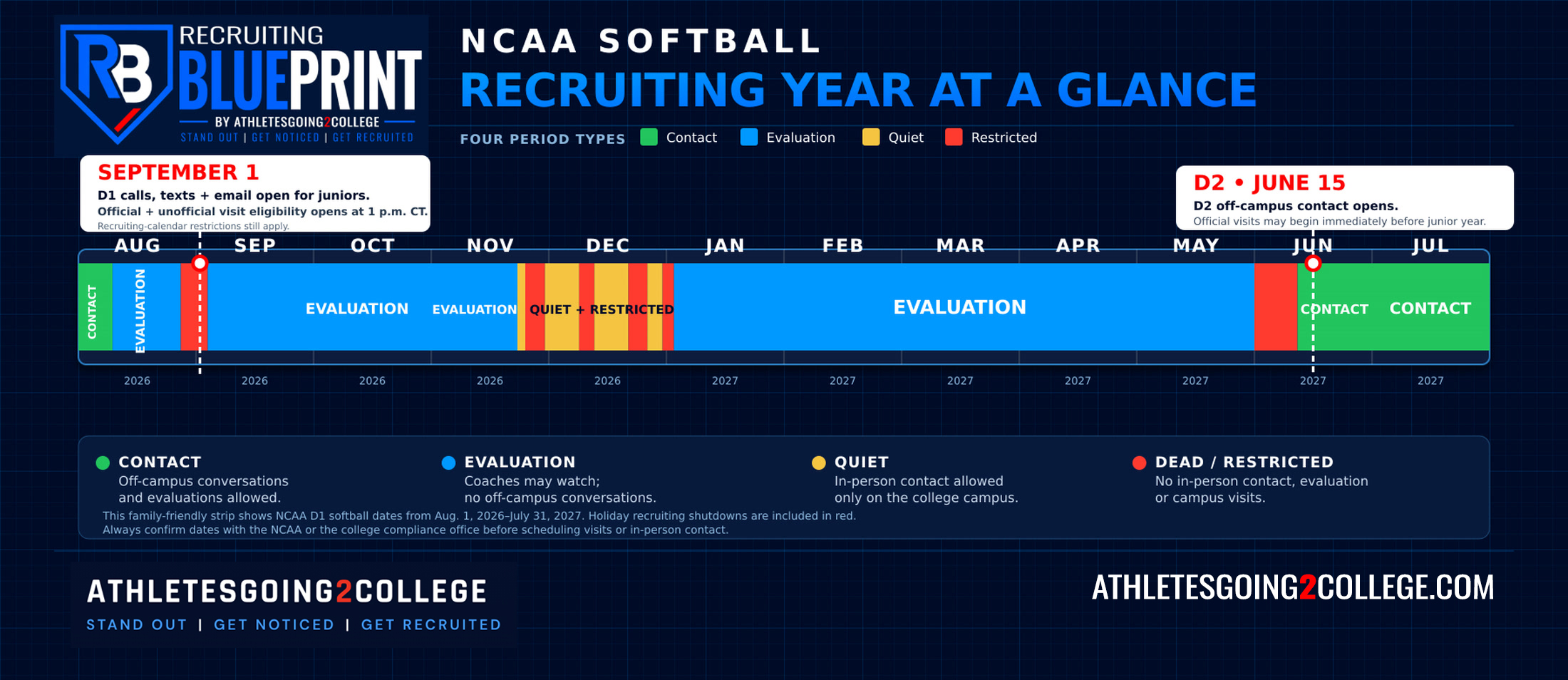
Division I softball, August 2026 – July 2027. Dates move every year — confirm the current calendar before booking travel.
The most permissive window. Coaches may make in-person, off-campus contact and evaluate you at competitions — home visits, school visits, off-campus meetings.
What it means for youThis is when a coach might show up at your tournament and actually talk to you afterward.
Coaches may watch and assess you at competitions, practices, or your school — but no off-campus contact is permitted. Watching is allowed; talking is not.
What it means for youA coach can be in the stands, evaluating hard, and walk past you without a word. That is compliance, not disinterest.
In-person contact is permitted only on the college's own campus. Coaches can host official and unofficial visits, but cannot travel to see you.
What it means for youA good window for campus visits. A bad one for expecting a coach at your showcase.
No in-person contact or evaluation anywhere, on or off campus, and no official or unofficial visits. Calls, texts, and emails are still allowed.
What it means for youDon't schedule a visit into one. If a coach goes quiet in late December, check the calendar before reading anything into it.
This is a structural difference, not a footnote. D3 has no designated dead periods and no calendar-based restrictions on when coaches contact recruits. If your athlete is targeting D3, the four periods above simply don't apply — and neither does most of the anxiety that comes with them.
NAIA and JUCO are similarly unrestricted.
The Division I softball calendar is republished every spring, and the specific dates move year to year. This page deliberately does not list them — a stale date is worse than no date. Check the current calendar at NCAA.org before booking travel around a specific week.
Freshman year — build the foundation
No coach is offering a ninth grader. What you do this year decides how ready you are when the gate opens two years from now.
- Get your core-course GPA right from the first semester — freshman grades count toward eligibility and they never come back
- Learn how recruiting actually works: divisions, scholarship math, the calendar
- Start capturing film. Full-game footage counts; you don't need a polished reel yet
- Track stats properly from day one, in GameChanger or equivalent
- Get honest about what level you could realistically compete at, and what would have to change
- D1Nothing. No calls, texts, emails, or DMs
- D2May call, text, and email
- D3May call, text, email, and send materials
- NAIA / JUCONo restrictions
Yes — a D2, D3, NAIA, or JUCO coach can legally talk to a freshman today.
Sophomore year — get visible and start reaching out
This is the year outreach begins in earnest. Your emails are legal and welcome long before a D1 coach is allowed to answer them.
- Register with the NCAA Eligibility Center — a fee applies, and fee waivers exist if you qualify for one on standardized tests
- Get your recruiting profile live so every email you send has a link in it
- Settle your realistic division range, then build a target list of 30–50 programs across Stretch, Target, and Foundation
- Start sending personalized emails. Expect near-silence from D1 and real replies from D2, D3, NAIA, and JUCO
- Choose exposure events where coaches recruiting your position and grad year actually attend — not the biggest ones
- Cut a real highlight reel from the season's film
- D1Still nothing, all year
- D2All electronic contact, plus off-campus contact and visits from June 15 after sophomore year
- D3All electronic contact; off-campus contact after this year
- NAIA / JUCONo restrictions
June 15 after sophomore year is the first real gate — and it's a D2 gate, not a D1 one.
Junior year — the year the phone can ring
On September 1 of junior year, every D1 restriction lifts at once: calls, texts, emails, DMs, off-campus contact, and both official and unofficial visits. Coaches who already know your name are the ones who reach out that day.
- Have film, stats, transcript, and profile fully current before September 1 — not after
- Send your strongest, most personalized wave of outreach in the days around September 1
- Take the calls. Prepare questions in advance; a first call goes better when you've thought about it
- Start visiting. D1 official and unofficial visits open September 1; D3 official visits open January 1
- Keep grades climbing — junior year transcripts carry the most admissions weight
- Prune the list. Programs that have gone cold after real follow-up get replaced, not chased
- D1From September 1: everything — calls, texts, email, DMs, off-campus contact, verbal offers, official and unofficial visits
- D1 limitSeven recruiting opportunities per year — contacts and evaluations combined — and from September 1 of junior year no more than three may be off-campus contacts. Visits don't count against it
- D2Everything, including off-campus contact and visits
- D3Everything; official visits from January 1
- NAIA / JUCONo restrictions
A verbal offer isn't binding on anyone. It only becomes binding when an aid agreement is signed. And the seven-opportunity cap is per school, not total — it limits how often one program can watch or meet your athlete, not how many programs can.
Senior year — decide well, and keep working
D1 rosters fill early in the fall. D2, D3, NAIA, and JUCO recruit right through spring and summer — which is why a senior without an offer in February is not out of options.
- Finish official visits and evaluate programs on culture, staff stability, academics, and honest playing-time picture
- Read every offer for what the aid actually covers and what has to be renewed each year
- Compare real net cost across every school still in play — sticker price is not the number that matters
- Complete the FAFSA and your admissions applications on the school's timeline, not the coach's
- Sign the athletics financial aid agreement when you're ready — there is no NLI anymore
- Keep emailing. Roster spots open late when commits transfer, get injured, or fall short academically
- D1Everything. The seven-opportunity limit resets each year, still capped at three off-campus contacts
- D2Everything
- D3Everything
- NAIA / JUCONo restrictions, and often still building rosters into summer
The NLI was discontinued in October 2024. If a coach says "sign the NLI," they mean the athletics financial aid agreement.
When a coach can first contact you
Contact-age rules are stable year to year. Dead periods and evaluation windows are not. Always confirm current rules with the governing body: NCAA.org · NAIA.org · NJCAA.org
Age-based eligibility, in one paragraph
In June 2026 the NCAA replaced the old "four seasons in five years" model with a single age-based eligibility period for Divisions I and II. The five-year clock starts at the earlier of first full-time college enrollment or the academic year following the athlete's 19th birthday — and once started, it runs continuously. Athletic redshirts and most waivers, including medical hardship, are eliminated.
It matters on this page for one reason: because the clock can start on a birthday rather than on enrollment, reclassing or a post-grad year may now consume eligibility rather than preserve it. Every athlete currently in high school is governed by this rule only.
A junior who hasn't started isn't behind on this timeline so much as compressed onto it. You do freshman through junior year work at once: profile, current film, honest division range, and a target list weighted toward the divisions that recruit latest. A senior in the fall has a narrower path at D1 and a real one everywhere else.
The athletes who genuinely run out of runway are the ones who wait until senior spring to start — not the ones who start late and work.
Next steps
ATHLETESGOING2COLLEGE
STAND OUT | GET NOTICED | GET RECRUITED
The step-by-step college softball recruiting system — six stops from learning how recruiting works to signing with a program that fits. Your athlete runs it, under their own name.
Start the Blueprint — $199/yr →$24.99/month or $199/year · No contracts · Cancel anytime
Recruiting rules change and vary by division. Always confirm current rules with the governing body: NCAA.org · NAIA.org · NJCAA.org