

What coaches are evaluating during outreach
Most athletes think recruiting is a talent evaluation. It is — but only partly. The outreach phase is a full-person audition, and everything you do communicates who you are.
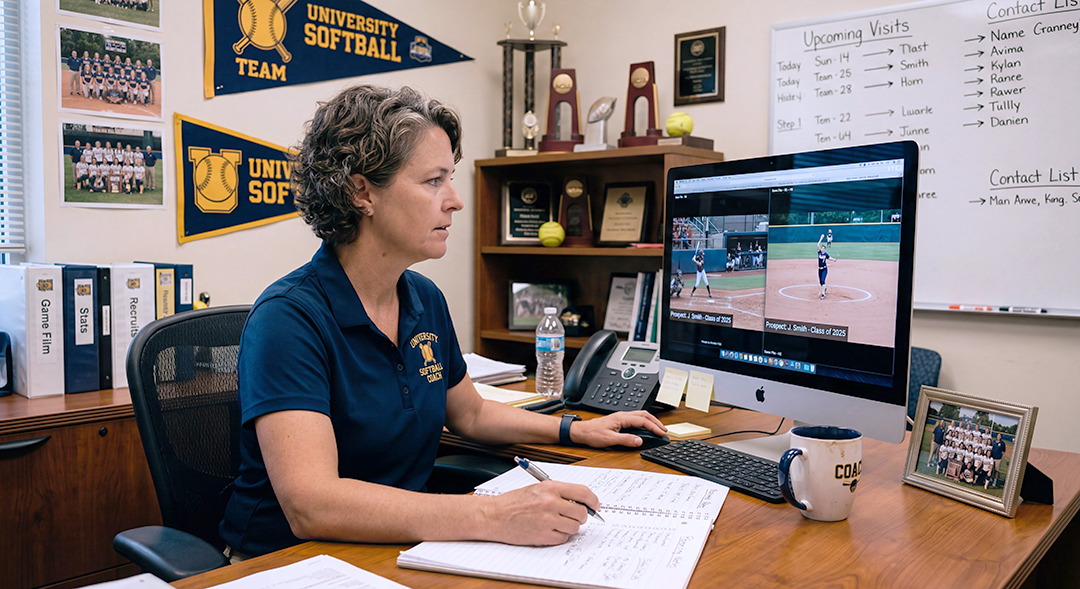
When a coach watches you compete, they're evaluating athletic ability. When that same coach reads your email, opens your profile, takes a call and watches how you carry yourself at a camp, they're evaluating something broader and more complete than ability alone.
Athletes who understand this show up differently in every interaction. Here's what's actually being assessed — specifically, concretely, and honestly.
Athletic ability and potential
Foundational, and it comes first. Coaches evaluate current ability relative to roster need, and developmental trajectory relative to where you'd need to be on arrival.
No amount of professional communication, academic excellence or strong character compensates for an athletic profile that doesn't fit the program's level. Outreach can't manufacture athletic fit where it doesn't exist.
Read through film, showcase attendance and camp performance. A coach who's watched you has a direct read; one who hasn't is forming a first impression from your email, profile and measurables.
Assessed against roster composition and projected graduation. A program with three sophomore shortstops isn't recruiting a shortstop, however talented. Timing and roster need filter the pool before ability does — which is why good athletes get no response for reasons that have nothing to do with them.
A pitcher whose velocity has climbed steadily since freshman year is evaluated differently from one who's sat at the same number for two seasons — even if today they throw the same speed. Coaches are recruiting who you'll be when you arrive.
Make the profile fast to evaluate. Current measurables in the profile and the first email; the best, most relevant film at the top of the video. A coach who can't assess a profile quickly moves to the next one.
Communication quality
The moment you send the first email you're being evaluated — not only on what it says, but on whether the communication suggests you're ready for the environment you're asking to enter.
- Correct grammar and spelling — not approximate. Typos signal an attention problem you don't need to explain twice.
- A clear opening — name, grad year, position, high school, travel team, without making anyone dig.
- Specific knowledge of the program — the coach's name, the conference, something real. An email that could go to any program signals that it did.
- A clear ask — "I'd like to know whether I could be on your radar for 2028" is an ask. "Hope to hear from you" isn't.
- A professional email address — firstname.lastname, not a nickname from year eight.
- Response time — a day or two signals engagement. A week signals otherwise.
- Consistent voice — if the first email sounds sixteen and the next sounds forty-five, coaches notice.
- Ability to carry a conversation — thoughtful questions, references to what was said last time, relevant updates.
Treat the first email as though it's the only one that gets read, because at many programs it is. Read it aloud before sending. If it sounds like an adult wrote it, rewrite it. If it sounds like you, send it. Writing the email →
Academic profile
Every coach at every level evaluates academics during outreach — not as a secondary consideration, but as a filter that removes a significant part of the pool before athletic evaluation happens.
Eligibility Center requirements are the floor. An athlete not on track for the 16 core courses and the minimum GPA isn't recruitable regardless of ability — coaches don't have time to recruit uncertain eligibility.
No athletic scholarships, so the entire financial proposition rests on academic merit and need-based aid. A strong academic profile makes D3 realistic; a weak one can make it financially impossible regardless of how you compete.
Eligibility is more accessible than the NCAA's — but coaches at academically strong NAIA institutions are still assessing whether you'd succeed in their environment.
- GPA, weighted and unweighted — they want the real number, and if the unweighted is much lower, expect that to matter.
- Academic trajectory — a 2.8 that climbed to 3.5 tells a different story than a 3.5 that's sliding.
- Course rigour — a 4.0 in an easy load reads differently than a 3.7 in a demanding one.
- Intended major, and whether it fits the season — be direct about it. The programs where it creates least conflict are usually the better athletic fit anyway.
- Test scores, where relevant — no longer required for NCAA eligibility, but plenty of institutional aid is still tied to score thresholds.
Don't lead with academics if they're a liability; don't hide them if they're a strength. If the GPA is 3.8, it goes in the first email. If it's 2.9, aim outreach at levels where that profile is competitive rather than spending junior year on programs whose minimums you don't meet.
Character and coachability
The hardest thing to evaluate from an email, and the most important to a coach who's going to spend four years with you. It's assessed across every interaction — especially the ones you don't realise are being watched.
Excuses after a poor at-bat, or accountability and the next play? A coach who watches an athlete throw a helmet after a strikeout has seen something they won't forget.
Receiving a correction and implementing it, listening, making eye contact, asking a follow-up. Coachability is visible in very short interactions.
An athlete who speaks negatively about a travel coach, a high school coach or teammates is signalling how she'd eventually talk about the college staff — and if that's you, experienced coaches hear it immediately.
Coaches can tell someone genuinely interested from someone working a mass list. It shows in the specificity of the questions, the quality of the follow-up, and whether you're listening when they talk.
Character can't be performed during recruiting. It's demonstrated by who you are when you don't think anyone's watching — so the only reliable preparation is the real thing. Treat every coach, teammate and parent the way you'd want to be treated. Coaches see all of it.
Fit — athletic, academic, cultural
The category that contains all the others. After ability, communication, academics and character, a coach is asking one question: does this athlete fit this program specifically?
Position, level, grad year and trajectory against what the program needs. A program that develops pitchers through intensive individual work is a different fit from one that rotates a large staff. Neither is better — they're different.
Whether you'd genuinely thrive in that environment. A self-directed learner fits a large university differently from a student who needs small classes — and coaches care, because a struggling athlete becomes a problem for the program.
Whether the team's standards are ones you'd embrace rather than tolerate. Some programs are intense, some family-oriented, some fiercely competitive internally. Excellent athletes fit different ones.
You won't fit every program you contact, and the ones that aren't a fit won't pursue you regardless of your profile. That isn't rejection — it's the market telling you something useful.
Pay attention to where the genuine interest is. It's one of the most reliable signals of actual fit you'll get.
Coaches evaluate parents too
Not secretly or unfairly — openly, because they've learned that a difficult parent situation doesn't improve after the agreement is signed.
Parent-written emails sent from an athlete's account are frequently identifiable — the vocabulary, the framing, the questions are an adult's rather than a sixteen-year-old's. Coaches factor it into her readiness to operate independently.
A parent who positions near the staff area, approaches coaches directly, or comments audibly on performances has been noticed — and plenty of coaches have made roster decisions on it.
Official visits include structured parent time. The questions you ask, and how you ask them, communicate what four years will look like. The parent who spends the Q&A arguing about playing time is telling the coach something they won't ignore.
A parent who emails to advocate, follows up on what she should follow up on, or supplies context she should supply herself has stepped into territory that belongs to the recruit.
None of this means parents should be invisible. You handle logistics, attend visits, ask the financial and academic questions, and provide counsel — all of that is genuinely yours.
What coaches are evaluating is whether the parent's role has crossed into territory that belongs to the athlete. The line is usually visible, and coaches who've recruited for years know exactly where it is.
Two recruits, two conversations
When a staff discusses a recruit who stood out during outreach, it sounds like one of these.
"She's competitive at our level — the film shows real ability, her measurables are in range, she's in the right environments. Her email was specific. She knew our program, asked a real question, sounded like a person rather than a form letter. Her academics are strong. At the showcase she competed hard, was coachable with our assistant, and never quit on a ball. And her parents watched from the stands."
She's being offered a campus visit.
"She's athletic — but her email was generic, her academic profile is uncertain, and her parent worked the sideline at the showcase. There may be talent there, but there are too many open questions and too many warning signs about the four-year dynamic. The maths doesn't work."
She might be on the radar. She isn't getting the call.
You control far more of this than it feels like.
The outreach phase isn't a passive experience of being evaluated. It's an active one of presenting — professionally and specifically — everything that makes you the right fit for a particular program. Then letting the market tell you where the genuine interest is.
Next steps
ATHLETESGOING2COLLEGE
STAND OUT | GET NOTICED | GET RECRUITED
The step-by-step college softball recruiting system — six stops from learning how recruiting works to signing with a program that fits. Your athlete runs it, under their own name.
Start the Blueprint — $199/yr →$24.99/month or $199/year · No contracts · Cancel anytime
Recruiting rules change and vary by division. Always confirm current rules with the governing body: NCAA.org · NAIA.org · NJCAA.org