

Write a coach email that gets a response
What to say, how to say it, and what coaches are deciding in the thirty seconds before they choose whether to reply.
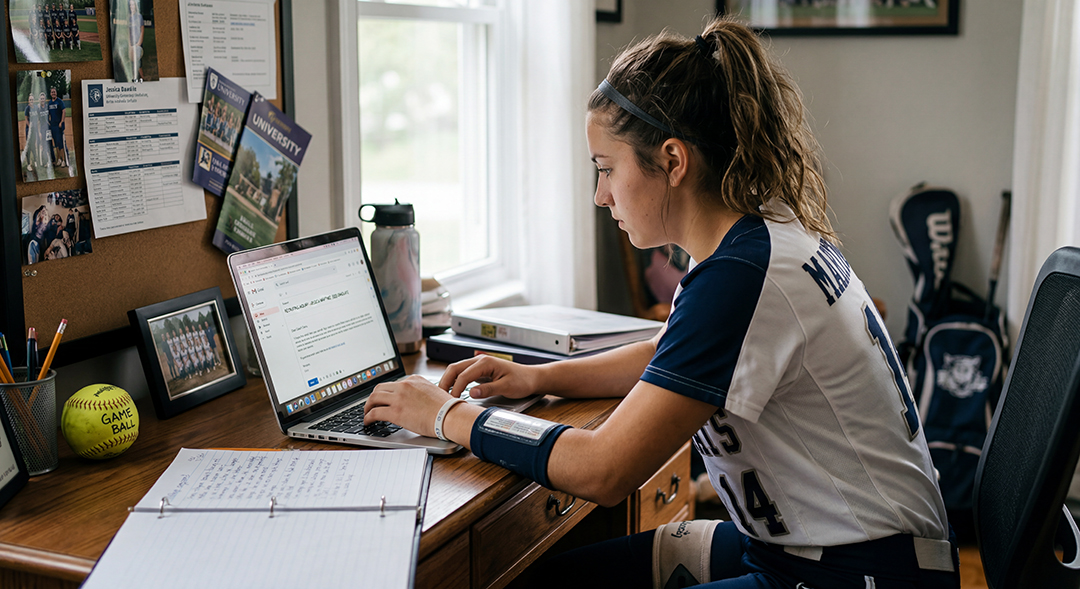
Most recruiting emails get ignored
Not because the athlete isn't good enough — because the email gave the coach no reason to respond.
A coach managing an active class reads dozens of these a week, quickly, looking for signals, deciding in less time than it takes to read a full paragraph.
The athletes who generate responses aren't always the most talented in that inbox. They're the ones whose email said something specific, something genuine, and something that made a coach want to know more.
Five questions, in about thirty seconds
A coach reading your email is answering these — usually in this order, usually before finishing it.
Position, graduation year, level context. If it isn't in the first three sentences, they've already moved on.
One real, specific detail — not the school's name — proves this wasn't sent to two hundred programs at once. Generic emails get no response.
Grammar, spelling, tone. The email previews four years of academic and team communication. The bar isn't perfection — it's professional.
"Hope to hear from you" gives a coach nothing to act on. A specific ask gives them something to do.
The things that end it: written by a parent, no film link, so long it requires scrolling, an unprofessional address, or an obvious copy-and-paste.
Anatomy of an effective first email
Five components. Each has one job. None longer than it needs to be.
The only part they see before deciding whether to open. Lead with position, graduation year, and one distinguishing fact so they know instantly whether you're in their window. Generic phrasing — "Recruiting Inquiry", "I am interested in your program" — gives no reason to open.
- 2027 LHP — 65 mph — Attending Your Camp July 12
- RH Pitcher | Class of 2027 | 4.1 GPA | AL Gold Circuit
- SS/UTL 2026 — PGF Platinum — .410 Avg This Season
- Catcher 2027 — [Your State] — Interested in [School] Softball
One job: enough specificity to assess fit in thirty seconds. Full name, grad year, position, high school and location, travel team and level, and one or two measurables that matter at your position.
"My name is Emma Rodriguez. I'm a right-handed pitcher in the Class of 2027 from Westfield High School in Sacramento, California. I play travel ball with the NorCal Golds 18 Gold at the PGF Gold level. My current fastball velocity is 64–66 mph with consistent command on both sides of the plate. I carry a 3.9 GPA."
Five sentences covering position, grad year, level, a measurable and academics. The opening is a business card, not a biography — save the story and the personality for later conversations.
The paragraph that separates a mass email from a real one — and the one most athletes skip. A coach spots a form letter in two sentences; "your program represents everything I'm looking for" was in the last forty emails they read.
The conference and what that level means to you · the coach's philosophy, referenced honestly · an academic program that fits your major · a recent team result · a genuine geographic or cultural connection
General reputation · "I've always admired" · anything equally true of fifteen other programs
"I've been following your program closely this season and was impressed by your conference tournament run. The combination of your pitching-development focus and the Business program's co-op track is exactly the environment I'm looking for — competitive on the field and serious in the classroom, and [School] seems to prioritise both."
You can't write this without researching the program first. That's the point — the research the email requires is the research that makes it worth sending. Researching a program →
Summarise what you offer and point to the film that supports it. The email isn't the film — it's the reason to watch it. Current-season stats as numbers rather than adjectives, with the competitive level attached; any standout recognition; upcoming schedule; and a direct link, placed here, where a coach is thinking about evaluation — not buried at the bottom.
"This season I'm hitting .418 with six home runs and 28 RBIs at the USSSA Elite level. I was named tournament MVP at the Top Gun Invitational in March. I'll be at PGF Nationals in Huntington Beach July 18–26. My recruiting profile and highlight video are at [profile URL]."
One click to the film or profile. Not a Drive folder that requires permission. Not a channel homepage with fourteen videos. Not a hunt for the right clip. One click. One video. Best content first.
Most emails end with a vague hope that gives a coach nothing to respond to. End with a clear, reasonable next step instead — plus contact details including a phone number, since some coaches prefer to reply by text or call as the relationship develops.
- "I'd like to know whether I could be on your radar for the 2027 class."
- "I've completed your recruiting questionnaire — is there anything else you'd want to see from me at this stage?"
- "I'll be competing at [Showcase] on [Date] — I'd welcome the chance for your staff to see me pitch."
Then a professional sign-off. "Sincerely" or "Best regards" — not "Thanks so much!!!!", and no emoji. The environment you're asking to enter is a professional one.
The velocities, averages and GPAs above are illustrative — they show the format, not a standard. They're not targets, and they aren't what any particular level requires.
This site doesn't publish measurable benchmarks, because no primary source for them exists. Put your real numbers in your email, whatever they are. Why we're careful with recruiting numbers →
Length, formatting, and the parent rule
Four to six short paragraphs, roughly 200 to 300 words. Long enough to be substantive, short enough to read in full. Paragraph breaks between sections, short sentences, no walls of text. No bullet points and no bold or italics in the body — this is a personal message, not a marketing document. Spell-check, then read it out loud; anything awkward spoken is awkward written.
The email is written by the athlete and sent from her account.
Not drafted by a parent and sent from her address. Not polished until it no longer sounds like a sixteen-year-old wrote it. Not sent "on behalf of" her.
Coaches are recruiting the athlete, and the email is how they assess whether she's ready for a college environment. An email clearly written by a parent tells a coach two things at once: this athlete can't yet communicate at the level college requires, and this family has a dynamic that may complicate four years of coaching and playing-time conversations.
Review an email if she asks — that's support. Don't write it.
Eight common mistakes
- Sending before you're competitive at that level. Not a question of age — you're allowed to contact coaches at any point in high school. It's a question of whether the profile supports the ask. An email to a program you're not yet in range for spends a first impression that doesn't reset. The readiness check →
- Sending the same email to everyone. Coaches can tell. The program-specific paragraph either exists or it doesn't.
- No film, or unusable film. No link asks a coach to evaluate what they can't see. Film behind permissions, or buried in a channel, loses coaches moving quickly.
- Statistics without context. ".450 this season" means something different at Gold nationals than in a rec league. Include the team and the level.
- Overly long emails. Enthusiasm doesn't require 600 words, and longer emails usually carry more filler than information.
- Following up within days. A follow-up three days later signals impatience. Two to three weeks is the window for a non-response.
- Apologising for the intrusion. "I'm sorry to bother you" is a weak opening. You have every right to contact coaches — lead with information, not apology.
- Typos and grammatical errors. One is survivable. Several in a short email signal a carelessness coaches associate with how you'll handle academic and team communication.
Ten answers. If every one is yes, send it.
- Subject line has position, grad year and at least one specific detail
- Opening has name, grad year, position, high school, travel team and a measurable
- The program paragraph contains a detail that couldn't appear in an email to a different school
- Current stats are included with competitive-level context
- The film link is present, direct, and one click away
- It closes with a specific, clear ask
- It's between 200 and 300 words
- Spelling and grammar are correct throughout
- It reads like a person wrote it — specifically, like you wrote it
- It's sending from your own professional email address
After the email goes out
A real message rather than an automated questionnaire link means the email did its job. Reply within 24 to 48 hours — that follow-up is its own skill.
One follow-up is appropriate — not a reminder, but a new piece of information. A result, an updated video, a showcase schedule, delivered with the same professionalism.
Redirect the energy toward programs that are engaging. Keep the school on the list, log it, and check back if something significant changes.
Silence is information, and it's usually not about you. More often it's a filled position or a closed class than a verdict on your ability — which is why it belongs in the tracker rather than in your head. Why the tracker decides outcomes →
Write it specifically. Send it professionally. Follow up consistently.
Next steps
ATHLETESGOING2COLLEGE
STAND OUT | GET NOTICED | GET RECRUITED
The step-by-step college softball recruiting system — six stops from learning how recruiting works to signing with a program that fits. Your athlete runs it, under their own name.
Start the Blueprint — $199/yr →$24.99/month or $199/year · No contracts · Cancel anytime
Recruiting rules change and vary by division. Always confirm current rules with the governing body: NCAA.org · NAIA.org · NJCAA.org