

How college softball coaches build their rosters
Coaches don't recruit the best available players. They recruit the players who fill the holes their roster is about to have — at a specific position, in a specific graduation year.
Understanding that one distinction explains most of what confuses families about recruiting: why a program stops responding, why an athlete with better numbers gets passed over, and why timing matters as much as talent. It also unlocks a skill almost nobody teaches — reading a roster.
A roster is a fixed number of chairs
Division I softball programs that opted into the House settlement carry a hard cap of 25 players. That's the whole roster — every class year, every position, pitchers included.
That's division, not a projection — and it's the number that reframes everything. A program isn't choosing among hundreds of recruits for a general pool of spots. In a typical year it's filling roughly six chairs, and each one already has a shape: a position, and sometimes a very specific one.
Real classes vary — a program with a big graduating class signs more, one with a young roster signs fewer or none at a position. But the ceiling is set by arithmetic, and the arithmetic is public.
How a coach actually decides who to recruit
Roughly this sequence, roughly every year. Understanding the order matters more than the details.
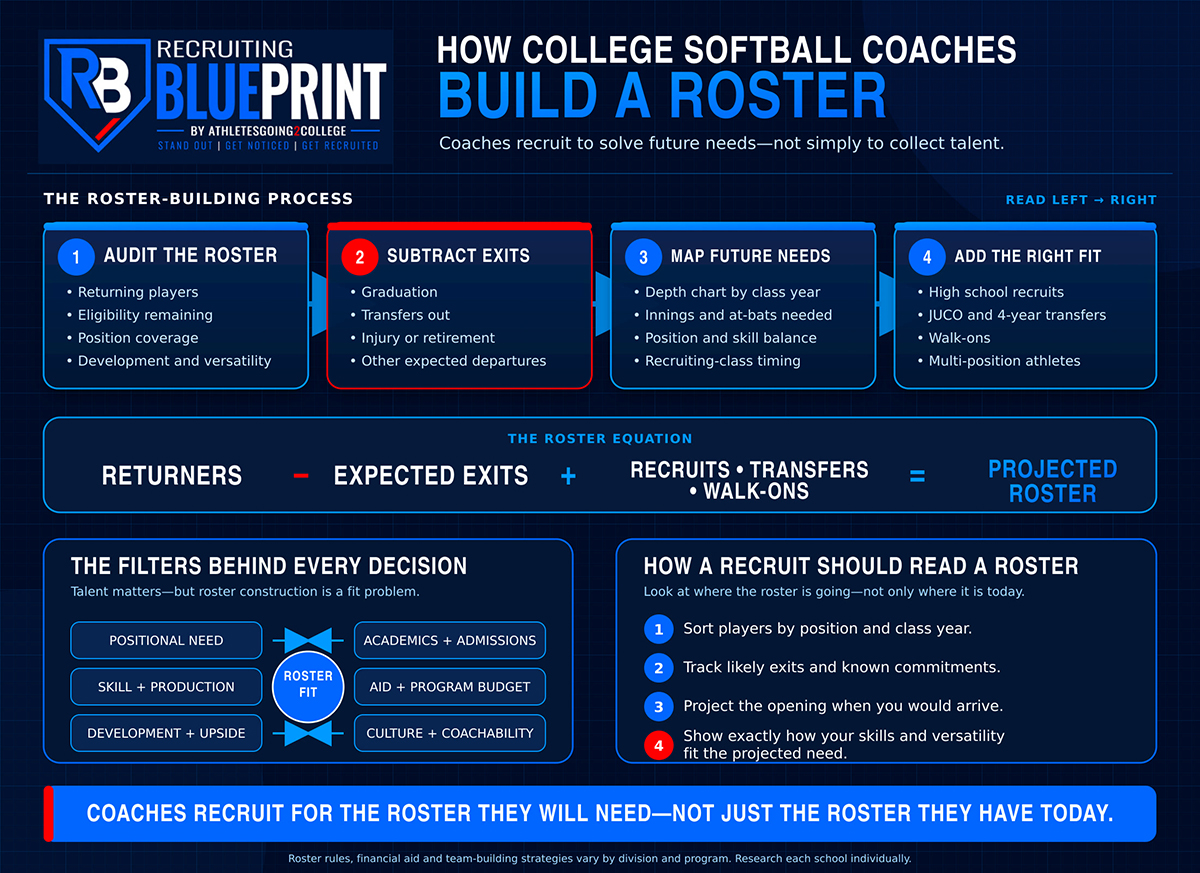
The four steps below, plus the roster equation and the reading method — save this one.
Who's returning, how much eligibility they have, and what's leaving — graduation, transfers out, injury, retirement. That's the number of chairs opening, and it's known with certainty only after the June portal window closes.
Not just how many, but what. Losing three outfielders and a catcher creates a very different need than losing three pitchers. Position, not headcount, drives the class.
A coach recruiting a 2028 class is also looking at who's a sophomore now. If the entire pitching staff graduates in the same year, that's a problem they solve two classes early — which is why some positions get recruited far ahead of others.
An immediate need — a starting shortstop for next season — often goes to the portal, where a proven college player exists. A need two years out is where high school recruits fit. Same program, same class, different answers per position.
This is the step families think comes first. It comes fifth. A coach isn't asking "who's the best player available?" — they're asking "who's the best player available who fills the specific hole I have?" Those are different questions with different answers.
An athlete can be objectively better than a recruit a program signs and still not get an offer there, because the program needed a catcher and she plays second base. That isn't a judgment about her. It's arithmetic about their roster.
Families who understand this stop reading silence as rejection — and start reading rosters instead.
How to read a roster in ten minutes
Every college program publishes its full roster — names, positions, class years — free, on its athletics website. It is the most useful and least used piece of recruiting intelligence available to a family.
Search "[school name] softball roster". It's on every athletics site, updated each season, and it costs nothing.
How many seniors, juniors, sophomores, freshmen? A roster with nine seniors is a program about to have a lot of chairs open. A roster with three is not.
This is the real work. How many catchers are on the roster, and what years are they? Two senior catchers means a need. A sophomore and a freshman catcher means that door is closed for several years.
You're not looking at this season — you're looking at the roster the year you'd arrive. Who's still there? A junior catcher is gone before you get there. A freshman catcher is a senior when you're a freshman.
Most athletics sites keep archived rosters. Compare them. Players who disappeared without graduating either transferred or left the program — and a pattern of that at your position tells you something about the program that no campus visit will.
You're a 2028 catcher. You look at a program's roster and find two catchers: a current junior and a current freshman. By fall 2028, the junior is long gone and the freshman is a senior.
That's a program with a catcher need in your exact year — and you now know it before you send the email, which means your first message can say so. That is a categorically different email from "I'm interested in your program."
Where a coach fills those chairs from
Projection. Two to four years of development inside the program, and the athlete grows into the role. Best fit for needs that are two or three years out, and for programs that develop rather than plug gaps.
Your argument: trajectory, ceiling, coachability.
Proof. College film, college at-bats, a known quantity who can contribute immediately. Best fit for an urgent hole — a starting position opening next season with nobody behind it.
Their argument: certainty. How the portal changed this →
Both, partly. Two years of college development and college film, with two years of eligibility remaining — a middle path that has become more valuable as programs weigh proof against projection.
Increasingly a strategic route, not a fallback.
Most programs use all three, in different proportions, for different holes, in the same class. That's why "do you recruit high school players?" is the wrong question and "how many spots in my class are you filling with high school recruits versus transfers?" is the right one.
Four practical consequences
A program that needs your position in your grad year is a better target than a more prestigious one that doesn't — regardless of how the two compare on paper. Roster fit beats program ranking, every time, for an athlete who actually wants to play.
"I noticed you have two seniors at catcher graduating the year before I'd arrive" tells a coach you did the work and understand their program. It is the single easiest way to be different from the hundred other emails in that inbox that week.
A program that doesn't respond may simply have no need at your position in your year. That's information about their roster, not about you — and it means the answer could change if someone transfers.
Rosters change. A program with no need last year may have three chairs open after the June portal window. Families who check once and conclude "they're not interested" miss opportunities that opened after they stopped looking.
Reading a roster tells you where the openings are. It doesn't tell you whether you're competitive for them — that's a separate, harder conversation with a coach who has watched you play, and no amount of roster analysis substitutes for it.
It also can't see everything. Coaches know about transfers before the public does, carry recruits who haven't announced, and sometimes recruit a position they appear stocked at because they know something you don't. Treat a roster as strong evidence, not proof.
Next steps
ATHLETESGOING2COLLEGE
STAND OUT | GET NOTICED | GET RECRUITED
The step-by-step college softball recruiting system — six stops from learning how recruiting works to signing with a program that fits. Your athlete runs it, under their own name.
Start the Blueprint — $199/yr →$24.99/month or $199/year · No contracts · Cancel anytime
Recruiting rules change and vary by division. Always confirm current rules with the governing body: NCAA.org · NAIA.org · NJCAA.org