

The follow-up system
How to stay on a coach's radar without crossing the line. The first email rarely produces the outcome — the follow-up is where recruiting relationships are actually built, or quietly abandoned.
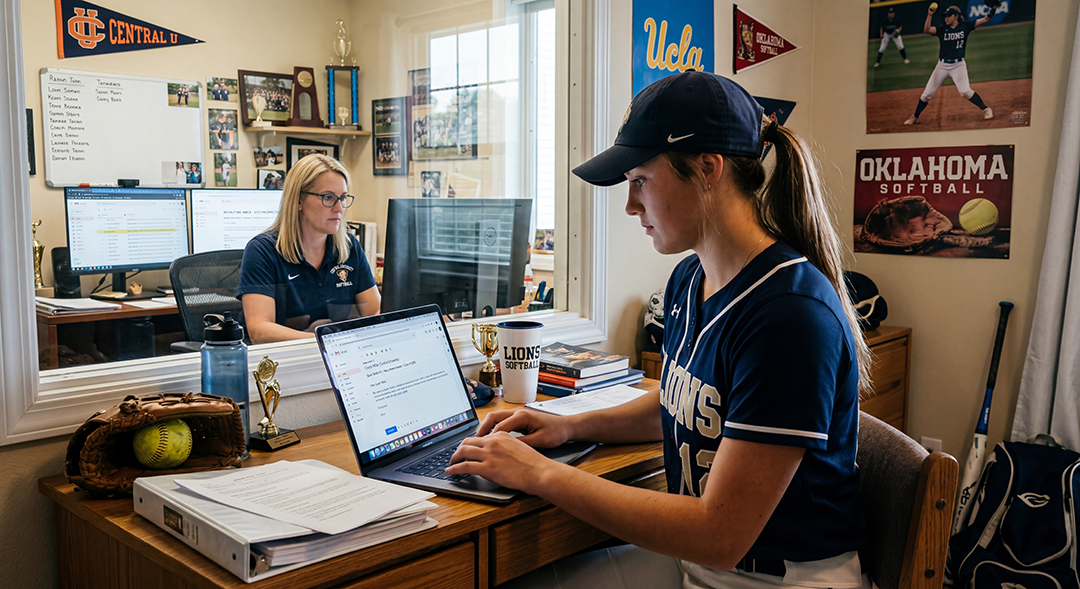
The recruits who get recruited consistently aren't always the ones who wrote the best first email. They're the ones who followed up professionally, updated coaches through a season, and kept relationships alive over months without going quiet or becoming a nuisance.
That's a skill rather than a personality trait. Here's the system.
Two failure modes, equally damaging
You send a strong first email, hear nothing, decide the program isn't interested, and move on.
You may be right. Or you may have emailed during a road-trip week, a dead period, a staff transition, or a stretch that simply doesn't move at the pace anxiety expects. Plenty of recruits get overlooked because they read silence as rejection and stopped before a coach ever properly evaluated them.
First email, follow-up a week later, another three days after that, then "did you get my email?", then a minor update.
That signals neediness, poor judgment about professional norms, and a preview of the family dynamic over four years. Coaches who've recruited long enough recognise the pattern — and respond by going quiet.
The system navigates between them: persistent without pushy, consistent without excessive, and always adding something real rather than checking in.
Every follow-up has to earn its place
One question before you write: does this give the coach something they don't already have?
A follow-up that restates the last email adds nothing. One asking whether they received it adds nothing and implies they were negligent. "Just checking in" adds nothing and spends their time.
A tournament result, a statistical update, a recognition, a personal best, or an upcoming schedule.
A GPA update, an honour-roll recognition, a test score, or a major you've decided on.
An event they might attend, a visit to coordinate, or an approaching decision timeline. Timing a schedule share →
They won a conference tournament, the coach gave an interview you found interesting, a schedule was announced that overlaps yours.
If you can't name which of the four it is before you start writing, it isn't time to send it.
Timing for every situation
Different situations, different clocks. These are the seven you'll actually encounter.
One brief email that opens with new content — not "I wanted to follow up". Once only, unless a time-sensitive event they might attend warrants a short heads-up.
After two non-responses: keep the program on the list, update the tracker, reconnect if something significant changes.
The most time-sensitive follow-up in the system. A coach who reached out is warm, and the longer you take the further down the stack you slide.
Answer their questions. If they didn't propose a next step, propose one — the goal is moving from email to a call. Why the channel shift matters →
Coaches miss calls. If nothing comes back, send a brief email — not to report that you called, but to deliver what the call would have said, plus a note that you'd welcome connecting at their convenience.
One of the most important emails in the process. Same day or first thing next morning. Reference something they said, answer any open question, confirm next steps.
Set the next follow-up date in the tracker before you close it.
This one carries enormous weight. Be specific to the visit — a conversation with a player, something the coach said, a moment from the tour.
It's also the right moment to be honest about where the program stands in your process.
For established relationships not yet at the visit or offer stage. A paragraph at most, always with one new relevant thing.
The goal isn't to ask for anything — it's to remain present while your profile develops.
If a coach has shown interest and you're nearing the end of junior year without direction, it's professional to ask about their timeline.
A brief, honest email beats letting the relationship drift into senior-year uncertainty. Coaches appreciate directness here.
Four things every follow-up does
The first sentence delivers the information — the result, the updated GPA, the showcase. Not "I'm following up" or "just checking in", both of which are invisible from overuse.
Three to five sentences. The coach has the context; this adds one update and one forward-looking line. Longer signals you're not yet calibrated to professional norms.
Not a demand — a natural next step. "I hope to see you at PGF in July." "I'd welcome a quick call if your schedule allows." It keeps the relationship aimed at something.
A coach who can hear a parent's voice in a follow-up has a data point they'll carry through the rest of the relationship.
The seasonal update, and the post-call email
Most athletes who emailed in the autumn go quiet all winter, then reappear in spring hoping to restart relationships that cooled months ago.
The ones who send a short update in January or February keep those relationships warm and arrive at spring showcase season with coaches already current on their profile. Two or three paragraphs. It asks for nothing.
- Offseason work, specifically. "Added 3 mph to my fastball working with a private pitching coach" beats "worked hard this offseason" — and it's the same sentence length.
- Where you'll compete this season — team, level, the major events on the schedule.
- Academic updates — recent-semester GPA, a recognition, a major you've chosen.
- A link to the updated profile if new film has gone up.
- One sentence of genuine continued interest — present, not effusive.
Within hours, and it references three things: something the coach said, any question or action item from the call, and the next agreed contact point.
It isn't a summary — you were both there. If the call produced a specific next step, confirm it in writing so nobody leaves with a different impression of what was agreed.
And if it produced no next step, create one. "I'll send my updated schedule next week." You own the next action, you set the date, and you deliver it.
An active recruiting month
Under two hours a week — and it's the two hours that keeps everything moving.
Open the tracker. Review follow-up dates, identify every program with one due this week, flag anything that's gone six-plus weeks without contact, and plan the week.
Write and send the week's follow-ups. One new piece of information each, three to five sentences, a specific forward line at the close. Log each one with its new follow-up date.
Coach emails → answer that day or first thing next morning. Coach calls → post-call email the same evening. Visit ends → the thank-you goes out before bed.
Update the tracker. Move statuses that changed, set dates on anything without one, and put anything specific from a conversation in the notes field.
When it cools, and when to stop
A program showing genuine interest sometimes goes quiet — usually for reasons that have nothing to do with you. Roster needs shift, a higher-priority recruit commits, the person who was recruiting you changes roles.
Send one additional genuine follow-up. A new piece of information, the same professionalism as the first email — not a frustrated inquiry about the silence. A coach doesn't owe an explanation, and asking for one confirms whatever instinct made them go quiet.
Then keep the program on the list, set a reminder three to four months out, and reconnect if the situation changes.
- They've said explicitly they're not recruiting your position or class. Acknowledge it politely and update the tracker.
- Two emails, no response. The initial outreach plus one follow-up is a reasonable effort. Two non-responses are market feedback — redirect the energy.
- You've committed elsewhere. Template 10 goes out and the relationship closes gracefully. The softball world is small, and a coach told directly remembers it.
Outside those three, the cadence continues as long as you're uncommitted. A program that hasn't responded isn't necessarily one that never will — timing in recruiting is genuinely unpredictable, and the athlete who stayed consistent is the one who's available when it changes.
A system that exists only in your head degrades as the list grows across months and years.
Every contact gets a follow-up date the day it goes out. Every response gets a status update the day it arrives. Every conversation gets notes the day it happens.
The tracker manages the memory of the relationships — so an athlete juggling school, practice and travel can show up to every coach conversation as prepared and specific as if she'd been thinking about nothing else all week.
Next steps
ATHLETESGOING2COLLEGE
STAND OUT | GET NOTICED | GET RECRUITED
The step-by-step college softball recruiting system — six stops from learning how recruiting works to signing with a program that fits. Your athlete runs it, under their own name.
Start the Blueprint — $199/yr →$24.99/month or $199/year · No contracts · Cancel anytime
Recruiting rules change and vary by division. Always confirm current rules with the governing body: NCAA.org · NAIA.org · NJCAA.org