 For Parents
Parent Recruiting Checklist
Practical ways to support your athlete through the recruiting process
Your athlete has a recruiting checklist — seven steps, a profile to build, emails to write, coaches to contact, offers to evaluate. This one is yours. The specific responsibilities that belong to you — the ones nobody else on your family’s team can do as well, and that give her a genuinely better chance when handled well.
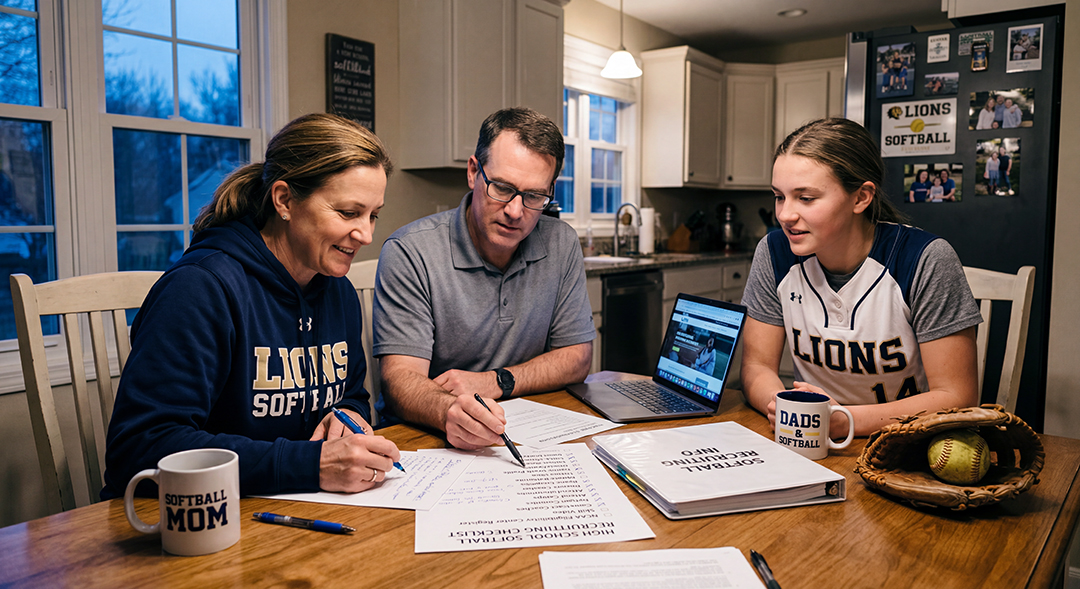
Not a copy of her checklist with your name on it — a checklist of the responsibilities that fall through the cracks when parents assume they belong to someone else. The items are organized by stage; work through each as it arrives, and return to the full list whenever the process feels like it’s getting away from you.
The goal isn’t to make you more involved. It’s to make sure your involvement is in the right places — so she can own the places that belong to her.
Before you begin
The foundation work — before the first email, showcase fee, or visit. Families who skip it report the process was harder and more expensive than it needed to be.
Have an honest conversation about whether she genuinely wants to play in college
Not whether she’s always played, or whether stopping would disappoint people — whether she personally wants the experience: the schedule, the demands, the years of continued investment. The answer should come from her, in her own words. If you’re not certain she’s said it clearly and recently, have this conversation before anything else.
Have an explicit conversation about who owns the process
She does — research, emails, calls, leading visit conversations, the final decision. You support, advise, attend, ask questions in parent time, handle logistics, provide financial context. Say it directly: “This is your process. The emails go from your account in your words. Tell me what you need from me.” Families who set this clearly up front have far fewer role tensions later.
Understand the division landscape — honestly
Get a realistic picture of what level is likely to produce genuine opportunities for your athlete at her current development. Have a specific conversation with her travel coach — not “how talented is she,” but “what level is she realistically competitive for right now, and what would need to develop to change that.” Educate yourself on what the divisions actually mean (see Why College Sports Are Worth Pursuing), not the prestige hierarchy from travel-ball culture.
Establish a realistic recruiting budget
Costs accumulate over one to three years: showcase fees, travel, lodging, meals, unofficial-visit costs, profile subscriptions, camps. Estimate three to five major showcases (with travel) plus platform fees, camps, and two to three unofficial visits — then compare to what your family can spend without financial stress that distorts the decisions themselves.
Read the financial aid overview
Before any offers arrive, understand how athletic scholarships actually work — the equivalency system, partial-award reality, the interaction of athletic and academic aid, and net cost (the only number that matters). Read Understanding Scholarships & Financial Aid before the process begins, and again when the first offer arrives.
Academic foundation
These belong to the family, not the athlete alone. Eligibility is a shared responsibility, and gaps discovered late fall on everyone.
Confirm NCAA core-course status with the guidance counselor
D1 eligibility requires 16 specific core courses completed before graduation. Meet with the counselor to review which are done, which remain, and whether the four-year plan completes all 16. Do this no later than the end of freshman year — earlier is better.
Verify NCAA Eligibility Center registration
At eligibilitycenter.org, confirm the account is created and maintained — no later than end of sophomore year (junior is manageable but late; senior creates problems). Note: the Profile account is free, but the Academic & Athletics Certification account ($110 domestic / $170 international) is what’s required for D1/D2 before an official visit, signing, or competing.
Monitor the unweighted core-course GPA each semester
NCAA eligibility uses the unweighted GPA in core courses — not overall, not weighted. Track it each semester, know the minimum for her target levels (D1 2.3, D2 2.2; D3 institution-set), and know your buffer above it. A declining core GPA in sophomore or junior year is more urgent than almost anything else on this list — address academics before showcases.
Make a standardized-testing plan — for admission & merit aid
Tests are no longer required for NCAA eligibility (the requirement was eliminated in 2023 and the old D1 sliding scale is gone). But many colleges still require or consider the ACT/SAT for admission, and scores drive academic merit aid at every level — so most athletes should still plan to test. Most test at least twice: a baseline in sophomore or early junior year, and a second attempt junior year to improve it.
Run the net price calculator for every serious school
Every college is federally required to provide one. It estimates your aid package from income, assets, GPA, and scores before applying. Run it for every serious option, at every division level, before any visit — estimates, not guarantees, but the baseline comparison you need to evaluate honestly.
File the FAFSA as early as possible in senior year
The FAFSA opens in the fall of senior year (historically October 1, though the date has shifted in recent years) — file as early as possible. Some institutional need-based aid is first-come, so late filers miss aid they’d qualify for. Filing isn’t a commitment to any school; it’s a prerequisite for need-based aid across institutions at once.
Profile & preparation
Verify the recruiting profile is complete and current
Before outreach, audit it: current-season stats, verified measurables, current GPA and academic info, intended major, Eligibility Center number, grad year, contact info, a working video link, and a complete personal statement. Every section filled, no placeholder text, video from within the last season, and the link working from a browser not logged into the platform.
Build the research infrastructure
Your job is to help establish and maintain the system, not manage it for her. A working school list across multiple division levels, organized into realistic / stretch / safety tiers, plus a tracking system — a spreadsheet, the College Search Dashboard, or another tool — capturing who’s been contacted, when, the response, and the next action.
Review her outreach emails before they’re sent — review, don’t rewrite
Read each draft and give specific feedback: specific to this program or generic? Free of typos and casual language? Does it clearly state who she is, why this program, and what she offers? Appropriate length? Return it with feedback and let her revise. Don’t edit it yourself and send it from her account.
Campus visits
The most time- and attention-intensive phase of your direct involvement. Do them well.
Read A Parent’s Guide to Campus Visits before the first visit
The Parent’s Guide to Campus Visits covers what to observe, which questions belong to you, what not to do, and how to debrief afterward without distorting her evaluation. Read it before the first visit — not during, not after.
Prepare your own question list before each visit
Parent questions differ from athlete questions — scholarship renewal conditions, staff stability, injury protocol, athlete graduation rates, academic support, the financial aid office’s full-package picture, institutional financial health. Questions Only Parents Should Ask provides the full list by category; select the most relevant for each program.
Schedule a separate financial aid office meeting on every official visit
Don’t let the financial conversation happen exclusively through the coaching staff. Request an independent meeting with financial aid to understand the complete package — athletic, academic merit, need-based. If the program doesn’t facilitate it, request it yourself. A decision this size deserves direct access to the people who control the financial information.
Take notes after each visit — immediately
Within a few hours, write what stood out positively, what concerned you, how players carried themselves, how staff interacted, what facilities and academic support actually looked like beyond the tour, and what wasn’t answered. These become your reference when comparing under pressure weeks later — and force you to identify what you actually observed.
Debrief with her after each visit — in the right order
Ask what she observed and felt before you share yours — her experience is the primary input, yours secondary context. If something concerned you, share it as a question, not a conclusion. Give it 24 hours before the substantive debrief; the emotional high or low of a visit settles meaningfully in a day.
Compare net costs across every visited school
As each visit happens and financial information arrives, enter it into the College Cost Comparison Tool — it compares cost of attendance, scholarships, academic aid, and net cost across up to five schools with a four-year projection. Complete the full comparison before any commitment conversation moves toward a decision.
Offers & decisions
Get scholarship terms in writing before any commitment
Verbal offers aren’t binding on either party. Before your family treats an offer as real — before she says anything that could read as a verbal commitment — ask the staff to send written confirmation: the dollar amount, what it covers, the duration, and the specific renewal conditions. A program that hesitates to put terms in writing prefers you to rely on verbal assurances.
Verify scholarship renewal conditions specifically
Ask directly: what conditions would reduce or not renew it? What’s the program’s actual renewal history? What happens if an injury prevents competing? What if the head coach leaves? Under the House settlement, opt-in D1 programs can’t cut athletic aid for athletic performance, injury, or roster-management decisions (aid can still be affected by academic ineligibility, fraud, serious misconduct, or quitting) — the answers should align with that. Responsible questions, not hostile ones. Document the answers.
Complete the Before You Sign checklist before any agreement is signed
Before You Sign covers everything to verify before the financial aid agreement — the binding document — is signed. More comprehensive than this list for the pre-signing phase. Work through it completely; don’t sign anything until every item is addressed.
Resist pressure to decide before the evaluation is complete
Some timeline pressure is legitimate (class-size limits); some is a tactic to get a commitment before your comparison is done. Your family is entitled to adequate time to visit, review the package, compare options, and discuss privately. A coach who says the offer expires in 48 hours without time for evaluation is applying pressure that should itself be a data point. A commitment made under pressure is more likely to be the wrong one.
Have the honest conversation about what a good outcome looks like at every realistic level
Before any commitment, your family should be able to articulate genuinely — not just tolerantly — why any realistic division level would still be a good outcome. If you can’t find genuine enthusiasm (not resigned acceptance) for a D2 or D3 outcome before one arrives, the time to examine that is now — not when the offer comes.
After commitment
The process doesn’t end at commitment — the transition from committed to enrolled has its own checklist.
Confirm Eligibility Center certification before the agreement is signed
The Eligibility Center must certify academic eligibility before she can receive athletic aid. Confirm the Certification account is complete, documentation submitted, and certification expected before the financial aid agreement is signed. Resolve any outstanding eligibility questions before signing — not after.
Review the financial aid agreement before it’s signed
The financial aid agreement is the binding document — the National Letter of Intent was discontinued in 2024, so for D1/D2 the financial aid agreement now serves that function. Once signed, it commits her to the institution for one year and the institution to the documented terms. Read it; confirm the terms match what was offered and documented in writing. If anything differs — amount, conditions, renewal — address it before signing. Don’t sign a document you haven’t read.
Handle enrollment logistics before August
Housing applications, academic advising, course registration, meal plan, medical/athletic clearance — family logistics that need your involvement to complete on time. Most institutions have firm deadlines; missing them creates problems that are harder to resolve after the semester starts.
Connect with the program and future teammates before arrival
The transition is smoother for athletes who’ve begun building relationships before move-in. Encourage her to join team communication channels, attend pre-enrollment events, and reach out to teammates she connected with during recruiting. Your role is encouragement — the relationship-building belongs to her.
Have the independence conversation — explicitly
Before she leaves, talk about what her independence looks like and what your communication and involvement will be going forward. Not withdrawing support — establishing the right relationship for the next phase, where she’s the primary agent in her own life and you’re the person she calls when she needs support, not the one managing her daily details.
A final note
This checklist is long because your role, done well, is substantive — real responsibilities, real financial decisions, real advocacy for your athlete’s wellbeing, and the self-discipline to stay in the support role when the management role feels more useful. The families who handle their responsibilities well, stay in their lane, decide on complete information, and build an environment where their athlete genuinely owns her process are the ones whose athletes consistently arrive at the right school — prepared, connected, and ready. That outcome is worth the work.
↓ Download the Parent Checklist (PDF)
Related Resources