 Parents Portal · Guide
Questions Only Parents Should Ask
There are questions your athlete should ask — and there are questions that belong to you
Not because she isn’t capable of asking them. Because some questions carry more weight and are more appropriately raised by the adults in the room — the people writing the checks, evaluating the institution as a long-term investment, and watching the coaching staff with a different set of eyes than a 17-year-old in love with the possibility of this place.
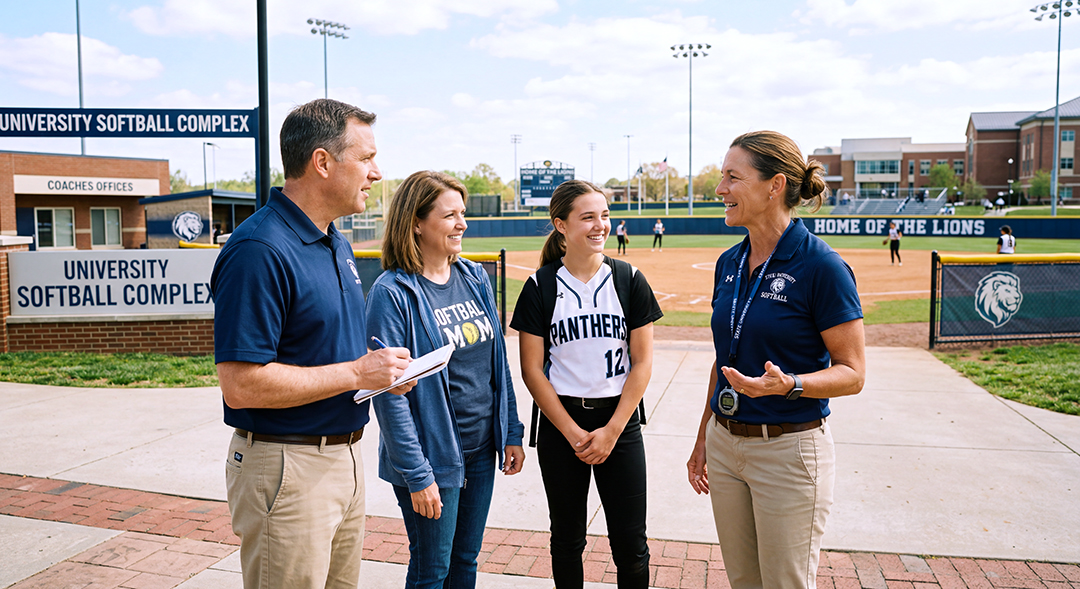
A few ground rules before you begin
These questions are yours to ask — but not during your athlete’s coach conversations. Not interrupting, not redirecting. She leads conversations with coaches and players; you observe, and when there’s time designated for parent questions — during the official visit, a separate parent meeting, or a private follow-up call — you ask yours.
Share the answers as observations and questions, not verdicts. You’re an advisor. She makes the decision.
Use these on campus visits, on calls with coaches and financial aid staff, and in the quiet debrief conversations afterward. Jump to a category:
Questions about the coaching staff & program stability
“How long have you been the head coach here — and what is your long-term vision for this program?”
This surfaces both stability and ambition. A coach building for eight years with a clear multi-year vision is in a different situation than one who’s been there two years and describes “potential” without direction. You’re assessing her investment in this institution and whether she sees her future here.
“Where were you before this position — and why did you come here?”
A coach who has moved among multiple schools in a short period may be building toward something larger; one who chose a smaller program intentionally and can say why shows a different level of commitment. Neither is wrong, but you need to understand which one you’re committing your daughter to.
“Can you walk me through any coaching-staff changes in the last two years?”
Turnover is normal; patterns of turnover are information. Who left, voluntarily or not, and why? A coach who answers directly and without defensiveness is demonstrating transparency. One who’s evasive, or blames all departures on the departing staff, is showing you how she processes accountability.
“If you left this position, what would happen to my daughter’s scholarship?”
The question most parents are afraid to ask and absolutely should. The answer is that the financial aid agreement is with the institution, not the coach — but what matters is how she answers. Warmth and clarity signals confidence in the program’s integrity; defensiveness tells you how she handles hard conversations.
“What is the relationship between this program and the athletic director — and how stable is it?”
AD changes can precipitate coaching changes. A coach with a strong, established relationship with the athletic department has more security than one navigating a recent administration change. A nuanced question that may require reading between the lines — but worth asking.
Questions about the financial package
“Can you put the scholarship terms — dollar amount, what it covers, renewal conditions — in writing before we decide?”
Not hostile — responsible. Any program that hesitates to document terms before commitment prefers you to decide on verbal assurances. Written terms protect your athlete and your family; a confident program has no problem documenting them.
“What specific conditions could reduce or end this scholarship — and when has that happened?”
Get specifics, not reassurances. Scholarships have been reduced for performance, roster-management, or academic reasons. Knowing exactly what triggers a reduction — and whether it has actually happened here — gives you real information rather than theoretical comfort.
“What happens to my daughter’s scholarship if she suffers a season-ending injury?”
Programs handle this differently — some guarantee continuation with medical-redshirt provisions, others are more discretionary. Know the answer before you commit, and ask: “Has this come up recently, and how was it handled?”
“Is this renewable for all four years — or reconsidered annually?”
The standard is annual renewal; some programs offer multi-year guarantees. More importantly, understand the renewal process: who initiates it, what your athlete is notified of and when, and what recourse exists if renewal is denied.
“Can we meet with someone from the financial aid office during this visit — separately from the coaching staff?”
The staff presents the athletic scholarship; the aid office can explain academic merit aid, need-based grants, work-study, and the full picture. The best financial picture combines both — and a program that facilitates this meeting is invested in helping you decide well.
“Has the total package you’re describing ever been reduced for athletes meeting their commitments?”
You’re asking whether the recruiting-time offer reflects what athletes actually receive throughout their careers. Programs that make initial offers and then adjust them downward over time have a pattern worth uncovering before you commit.
Questions about academic support & graduation
“What is the four-year graduation rate for softball players in your program — not the university overall?”
This number is tracked — ask for it specifically. A program that can’t access it quickly or deflects to the university-wide rate isn’t prioritizing athlete academic outcomes the way its materials suggest. A strong, confident answer demonstrates genuine academic investment.
“What academic support is available specifically to athletes — not just university-wide resources?”
Dedicated athletic advisors, study hall, tutoring, travel-conflict policies, priority registration — meaningfully different from general services. Programs that invest in athlete academics can describe their infrastructure in detail.
“What’s the process when my daughter misses class for travel — who communicates with professors, and how?”
Some programs proactively communicate with professors each semester, provide official documentation, and follow up on make-up work; others leave it entirely to the athlete. The difference matters enormously for a student-athlete managing a demanding schedule.
“Have athletes completed [intended major] while playing? Can I speak with one of those families?”
Not a current player — a parent or recent graduate who can speak candidly about how the academic experience actually worked. A program that can connect you quickly has a track record it’s proud of; one that struggles may not have the major-specific record you need.
“What percentage of athletes who leave before graduation do so by their own choice versus the program’s?”
A pointed question that surfaces transfer dynamics from a different angle. Strong cultures lose athletes mostly to athlete-initiated transfers for personal reasons; retention problems from the institution side show patterns tied to culture or coaching. A coach who answers honestly is worth trusting more than one who deflects.
Questions about health, safety & athlete welfare
“What is your injury protocol — who makes return-to-play decisions?”
This surfaces the program’s welfare philosophy more directly than almost anything. In healthy programs, injuries are evaluated by the team physician or certified athletic trainer and return-to-play is decided medically, not athletically. Listen for whether the answer is medical staff or coaching staff.
“Does the program have mental-health resources specifically for athletes?”
Anxiety, burnout, identity pressure, and the weight of competition are real. A program that has invested in mental-health support — and speaks about it without discomfort — takes the whole athlete seriously. A staff that seems unprepared for the question is showing you the program’s emotional culture.
“What is the program’s policy on athlete privacy — medical, performance, and internal team matters?”
This often surprises coaches because few parents ask. You’re evaluating whether the program has a thoughtful approach, or whether medical and performance information moves freely in ways that could affect your athlete’s confidence or reputation. Programs that take privacy seriously have thought about it.
“If my daughter is struggling, what’s your process for identifying and addressing it proactively?”
A staff with a genuine answer has a system — regular one-on-ones, a formal check-in process, assistant coaches who maintain close relationships. The specifics matter less than whether a specific, thoughtful answer exists. “We have an open-door policy” describes a reactive system, not a proactive one.
Questions about team culture & the daily reality
“What does a typical in-season week look like — hour by hour, not in broad terms?”
Coaches describe seasons in practice/games/travel. You want the real week: early lifts, film sessions, training-table meals, study hall, team meetings, travel departures. The gap between a general description and a detailed picture affects her ability to manage everything running alongside the sport.
“How does the staff handle conflict — between players, player and coach, and within the staff?”
A culture-and-leadership question few parents ask that reveals a lot. A staff that can describe a specific (anonymized) example and a thoughtful, fair, transparent process runs a healthy culture. One that insists conflict doesn’t happen, or describes only top-down resolution, may be telling you how your athlete’s voice will be heard.
“What happens to a player working hard but not getting the playing time she expected?”
Playing time is one of the most emotionally charged parts of college athletics. Whether coaches communicate proactively about role, run regular evaluations, and still invest in athletes lower in the depth chart tells you whether this program values everyone on the roster or just the starters.
“Can you connect me with a parent of a non-leadership player — and a parent of a recent transfer out?”
Coaches usually offer captains’ families, who present the program best. Asking for a non-leadership family surfaces a more representative freshman experience. Asking for a transfer family is more revealing still — a coach comfortable making that connection shows confidence in how departures are handled.
“What does your program do when a player’s performance is consistently below expectations?”
You’re asking about the accountability culture — whether conversations are early and developmental or late and punitive, transparent or opaque, supportive or “managed out.” It tells you a great deal about what she’s committing to if she arrives and faces early struggles.
Questions about the institution
“What is this school’s financial stability — and how has it affected athletic funding recently?”
Financially stressed schools sometimes cut athletic budgets in ways that affect scholarships, facilities, salaries, and competitive investment. Institutional financial health is largely public, and an administrator should speak to it transparently. A vulnerable institution carries risks a strong one doesn’t.
“What is the school’s reputation in my daughter’s intended field — and how does the alumni network actually function?”
A career question, not a sports question. The institution will be on her professional resume for life. Whether the name, the alumni network in her field, and the career-placement infrastructure will serve her at 25 and 35 — not just at 22 — is a parent’s appropriate contribution.
“What is the institution’s commitment to Title IX equity — and how does that translate to softball investment?”
Title IX requires equitable treatment of women’s athletics, but there’s wide variation between meeting the minimum and genuinely prioritizing women’s sports. Budget, facilities, marketing, support, and travel quality vary dramatically — understanding where this program sits has real implications for her experience.
Questions for the financial aid office — separately from the coach
Ask to meet a financial aid representative independently during the official visit. These belong in that conversation.
“Can you walk me through the full award letter we should expect — every component, included and not?”
Get a complete picture: athletic scholarship, academic merit aid, need-based grants, work-study, and loans, all itemized. Understand which components are free money and which must be repaid.
“Can we stack athletic and academic aid — and up to what limit?”
Many schools allow these to combine up to the cost of attendance; some have restrictions. Understanding the stacking policy before the award letter arrives prevents surprises.
“What’s the process for the FAFSA to be applied — and the timeline for aid decisions?”
Understanding the sequence between FAFSA submission, aid determination, and award-letter delivery helps your family plan — especially if she’s considering early signing and you need the financial picture complete by then.
“If the athletic scholarship is reduced or not renewed, what happens to the rest of the package?”
Academic and need-based aid is often independently determined. Knowing whether it would survive an athletic-scholarship change gives you a clearer picture of your family’s financial exposure.
“What has the typical annual tuition increase been over the last five years?”
Historical increases predict future ones reasonably well. Consistent 5–6% annual increases mean senior year costs substantially more than the freshman number suggests — essential for a realistic four-year projection.
Before and after every visit
“Am I evaluating this school for my daughter — or am I evaluating it for myself?”
The school that fits your vision of her future may not be the one that fits hers. The program that would have thrilled you at 17 may not be the one that helps her thrive. The scholarship amount that makes you feel the investment was validated may not correlate with the environment where she’ll actually grow.
Your questions should surface information that helps her make a better decision — not information that confirms the conclusion you’ve already reached. That’s the discipline this process asks of you. It’s harder than it sounds — and it’s the most important thing you can bring to the table.
Keep building your parent toolkit