

A parent's guide to campus visits
What to observe, what to ask, and what to avoid — so your athlete makes a better decision.
You're there to see what your athlete cannot see — not because they aren't perceptive, but because they're 17 and emotionally invested in the possibility of this place. Their defenses are appropriately down. Yours need to stay up.
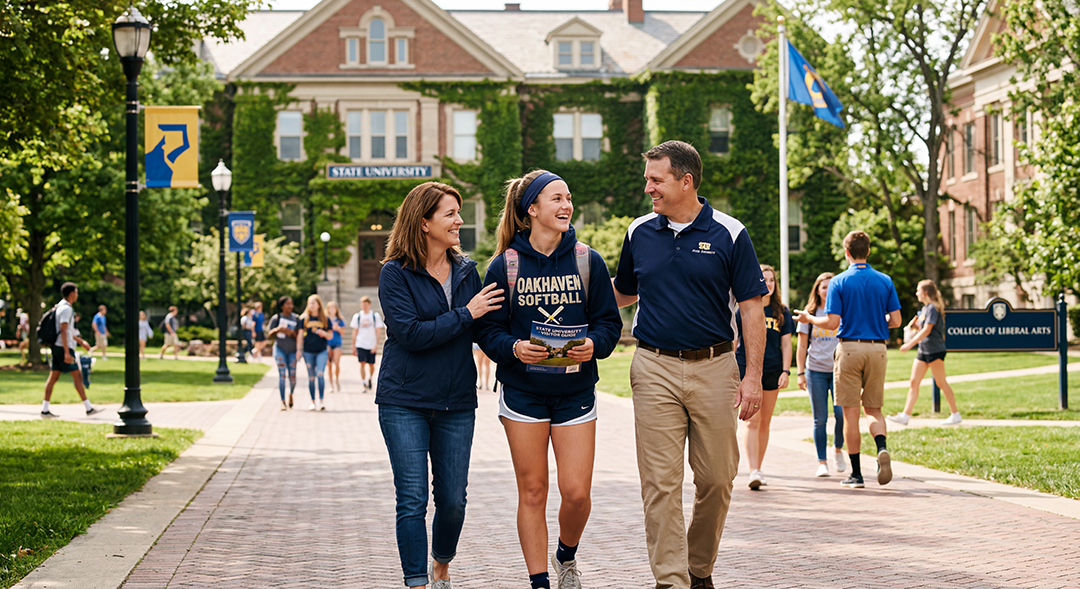
You can be genuinely excited about a campus, genuinely supportive of your athlete's experience, and still do the observational work parents are uniquely positioned to do. This guide covers what the visit types mean, what to observe, what to ask, how to behave, and how to debrief afterward in a way that actually helps.
What each one means
Unofficial visits
Arranged and paid for by your family — transportation, lodging, and meals. There's no limit on how many you take, and they're typically earlier in the process: a chance to get a feel for a campus before a formal offer.
The catch most families miss: for D1 softball, before September 1 of junior year you can absolutely walk a campus as a regular prospective student — but the athletics department cannot arrange the visit, host you, or hold any recruiting conversation. If you bump into the coach, they legally cannot talk recruiting. Plan accordingly and don't read the silence as disinterest.
Use unofficial visits to narrow your list. Don't make commitment decisions on them alone.
Official visits
Paid for by the school — travel, lodging, and meals within NCAA guidelines. The most structured, comprehensive evaluation available: meetings with staff, facility tours, time with current players, academic advising, and team meals. This is the visit that should precede any serious commitment conversation.
Mechanics worth knowing: one official visit per school. Division I now permits an unlimited number of official visits across different schools, still one per institution unless the head coach changes. D1 also requires your athlete to provide a transcript and proof of standardized testing before the visit — a paperwork trap families hit at the last minute.
When visits can begin — softball
One more scheduling reality: no official or unofficial visit for athletic purposes may happen during a dead period, and the Division I softball calendar is republished every spring. Check the current one before booking flights.
Your athlete should never commit to a school they haven't visited in person — no matter how enthusiastic they are, how well the calls have gone, or how much they trust the coach. If a coach pressures them to commit before an official visit, that pressure is a red flag worth noting. And remember a verbal offer binds nobody; it becomes real only when an athletics financial aid agreement is signed.
Preparation every parent should do
Research the program independently
Study the program's site, social media, and public info. Know the head coach's background, tenure, and record; know the team's recent performance and conference standing. Know what you don't know, so you can watch for it.
Check the roster over three years
Compare the current roster to two and three years ago. How many transferred out? Any pattern at specific positions? Normal turnover is healthy; unusually high transfer rates — especially at your athlete's position — warrant specific questions.
Know your financial parameters first
Understand your realistic budget before you set foot on campus. Use the school's net price calculator in advance and have a real picture of cost before you fall in love with the facilities. The College Cost Comparison Tool runs this side by side across programs.
Make a list of your own questions
Not your athlete's questions — yours, the ones from your research and financial review. Write them down; you won't remember them all in the moment.
Set role expectations with your athlete
Agree before the visit on how you'll each show up: they lead conversations with coaches and players; you observe and support; you debrief privately afterward. If something concerns you, you'll find a quiet moment — not interrupt in front of coaches. Agreeing in advance prevents friction.
From the moment you arrive
How are you greeted?
Are you met promptly and warmly by someone prepared for your visit and knowledgeable about your athlete — or is there confusion and waiting? Not about VIP treatment; about whether the program is organized and values the people considering it, and whether the first impression matches the recruiting conversation.
How do coaches interact with current players?
If you observe practice, watch tone, body language, how feedback is delivered, whether players seem energized or subdued, whether there's warmth alongside intensity. How coaches talk to athletes when they're not recruiting anyone is more revealing than any official presentation.
Do current players seem genuinely happy?
There's a difference between players being cheerful because they were asked to be welcoming and players genuinely thriving. Look for ease and authenticity — athletes who light up about teammates and coaches versus those carefully pleasant but saying little of substance.
What do facility details tell you beyond the tour?
The tour shows the best parts. Notice what isn't on it: the everyday training-room resources, the academic support space, quiet places to study, whether the weight room is well-maintained and staffed or mainly a recruiting visual. The details outside the tour reveal real daily investment.
How does the staff interact with each other?
A staff that communicates with warmth and respect internally is modeling the culture it's building. Assistants deferential to the point of discomfort, visible tension in unguarded moments, or assistants performing for the head coach are dynamics worth noting — your athlete will live inside this staff every day.
What to ask — and when
These belong to parents, asked during dedicated time with staff or advisors — not by interrupting conversations your athlete should be leading.
Coaching staff & stability
“How long have you been at this program — and do you see yourself continuing to build here?”
A coach two years in and vague about their commitment is a different risk profile than one ten years in and clearly invested.
“Can you tell us about any staff transitions in the past two years and how the program managed through them?”
Surfaces recent changes and how the program discusses them. Direct and confident is more trustworthy than evasive.
Scholarship & financial terms
“Can we get the scholarship terms in writing before we make any decisions?”
Responsible, not hostile. A program that hesitates to put terms in writing before commitment is telling you something.
“What are the specific conditions under which a scholarship would be reduced or not renewed?”
Get specifics — academic standing, conduct, roster management — and ask for them in writing.
“What happens to the scholarship if the head coach leaves?”
The financial aid agreement is with the institution, not the coach — but how they answer tells you how comfortable they are with direct financial questions.
“Can we meet with someone from the financial aid office during this visit?”
A yes — especially if the visit facilitates it — signals a program that wants you fully informed. A redirect back to the coach alone is worth noting.
Two separate protections get confused constantly, so know which is which.
Every Division I school — opted into the House settlement or not — has been required since August 1, 2024 to guarantee that athletic aid cannot be reduced or cancelled for athletic reasons: ability, performance, contribution to team success, or injury, illness, or a physical or mental health condition. Aid can still be reduced or cancelled for things like academic ineligibility, serious misconduct, violating team or school rules, or voluntarily leaving the team.
Separately, and specific to the House settlement: opt-in schools may not reduce, cancel, or fail to renew athletic aid as a result of the new roster limits. A roster squeeze is not a permissible reason to cut a scholarship.
So the useful question isn't whether these protections exist — it's what conditions still apply at this school, in writing, before anyone signs.
Academics
“What is the graduation rate for softball players in your program — not the university overall?”
Ask for the right metric for the division: Division I reports a Graduation Success Rate, Division II an Academic Success Rate, and Division III reports neither, so at a D3 program ask how they track it internally. A program that doesn't know its own number, or deflects to the university rate, isn't prioritizing athlete academics the way it may claim.
“Has your program had athletes complete [intended major] while playing? Can we speak with one of them?”
The most useful academic information comes from a current athlete actually doing what your athlete plans to do.
“What's the process when an athlete needs to miss class for travel or competition?”
Proactive or reactive? Established relationships with departments? It tells you how seriously academic support is actually practiced.
Player welfare
“What is your injury protocol, and who makes return-to-play decisions?”
Understand who makes health decisions once your athlete is away from home — a dedicated trainer, a team physician, a protocol that prioritizes health over availability.
“Does the program have mental health resources specifically for athletes?”
A staff that answers this specifically and without discomfort is operating in a culture that takes wellbeing seriously.
“What does the off-season look like — what's genuinely required versus strongly encouraged?”
“Voluntary” in college athletics is complicated. Understanding what's truly optional versus what carries implicit consequences reveals the full scope of the commitment.
The lines to hold during the visit
Don't lead conversations they should be leading
When a coach asks your athlete a question, let them answer. When they're talking with a player, don't insert yourself. When the coach explains the program, don't redirect to your own questions mid-sentence. Be supportive and observational; the conversations are theirs.
Don't express opinions on campus
Save assessments for the debrief — and even then, lead with questions. Comments on campus, positive or negative, can be overheard and create pressure before your athlete has formed their own view.
Don't ask scholarship amounts in public
Financial conversations belong in private, designated discussions — not over a team dinner or on a tour. Raising specifics publicly is awkward and signals money is your primary concern.
Don't compare this school to others during the visit
“At the last school the strength facility was much larger” puts coaches in a position they didn't invite. You're a guest — evaluate this campus on its own terms and compare privately.
Don't make commitments or hint at decisions
Even “we're really excited” or “this is at the top of the list” during a visit creates social pressure that closes off your athlete's ability to evaluate freely. Save enthusiasm for after, in the right context.
Don't take over the car debrief
The drive home belongs to your athlete. Ask one question. Let them talk. Resist delivering your complete analysis before they've processed their own experience — they were there; their perspective comes first.
How to process the visit together
Give it 24 hours first
The emotional high or low of a visit isn't a clear-headed assessment. Let the emotions settle a day before the substantive conversation about what you both observed.
Lead with their experience, not yours
“What stayed with you from the visit?” — not “Here's what I thought about the coach.” Their observations are the starting point; yours are additional information they factor in.
Share observations as questions
“I noticed the staff seemed a bit tense during practice — did you pick up on that?” is more useful than “I don't trust that staff.” Questions open conversations; verdicts close them.
Name what impressed you, too
A debrief that only surfaces concerns signals you're looking for reasons to rule the school out. Share what genuinely impressed you — it shows you're evaluating honestly, not advocating a position.
Ask the question that matters
After everything's discussed: “Can you picture yourself genuinely happy there — not just successful, but happy — four years from now?” Let them sit with it. The answer is more useful than any single data point.
Take notes while it's fresh
During an active junior year, the details of individual visits start to blur. Take notes immediately after each one — in the car or at the hotel — while observations are fresh: what stood out positively, what felt off, specifics you want to remember, questions that went unanswered. Use the College Cost Comparison Tool to keep each school's financial details organized separately. When you sit down to compare seriously, you'll want specific observations to refer to — not generalized impressions.
Stay curious underneath the impression
Every campus will have something impressive — that's the point. Programs put real resources into making official visits feel exceptional: the meals, the facility tours, the carefully chosen players, the coach who is warm and attentive in a way the daily relationship may or may not replicate. Your job isn't to be immune to that. You're allowed to be genuinely impressed. You're allowed to love a campus.
Your job is to keep asking — privately, afterward — whether what you saw was representative of daily life in this program, or the best version of itself presented for an audience. The athlete who arrives next August won't be the recruit treated to the best visit possible. They'll be the freshman navigating this program on a random Tuesday in October when nobody is performing for anyone. That Tuesday is what you're evaluating. Keep it in mind.
Keep going
ATHLETESGOING2COLLEGE
STAND OUT | GET NOTICED | GET RECRUITED
The step-by-step college softball recruiting system — six stops from learning how recruiting works to signing with a program that fits. Your athlete runs it, under their own name.
Start the Blueprint — $199/yr →$24.99/month or $199/year · No contracts · Cancel anytime
Recruiting rules change and vary by division. Always confirm current rules with the governing body: NCAA.org · NAIA.org · NJCAA.org