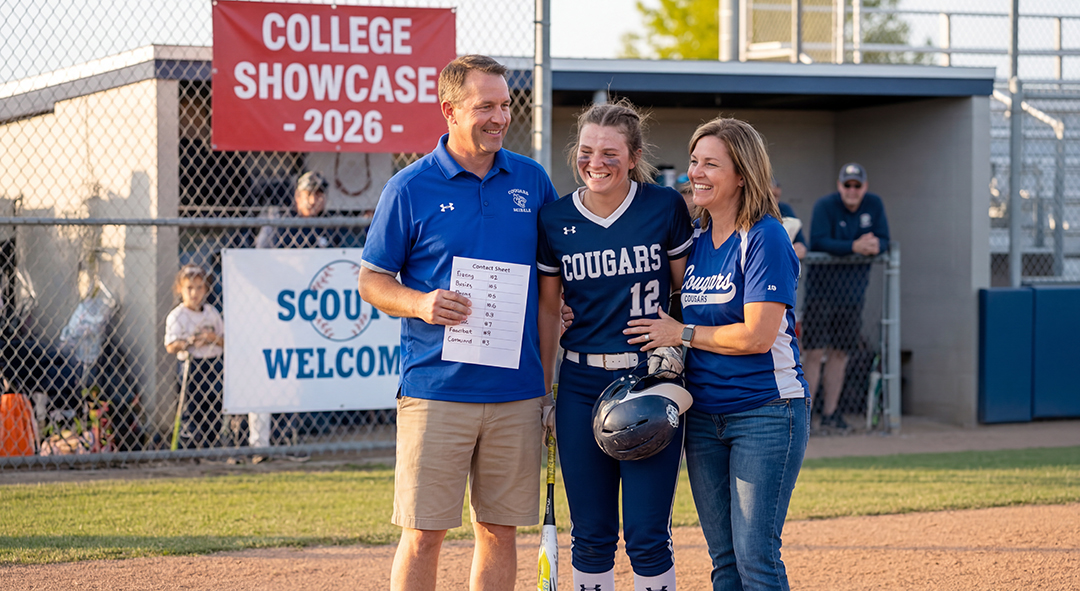
What Your Softball Athlete Is NOT Telling You

She tells you she's fine. She tells you she has it under control.

Some of that is true. Some of it is what she thinks you need to hear. And some of it is what she has not yet found the words to say — to you, or to herself.

This guide is not about what your athlete is hiding from you. It is about what is happening inside the recruiting process that most athletes cannot fully articulate — the fears, the pressures, the confusions, and the emotional weight that live underneath the highlight videos and the commitment checklists.

Understanding this does not make you a better recruiter. It makes you a better parent. And in a process this long and this personal, that matters more than almost anything else you can offer.


1

She Is Not Confident She Is Good Enough — Even If She Looks Like She Is

Here is something almost no athlete says out loud to her parents during recruiting: "I'm not sure I'm actually good enough for this." It does not matter how many offers she has received, how many coaches have called, or how many times you have told her she is talented. The internal question — am I really good enough? — runs quietly in the background of nearly every athlete's recruiting experience.

The travel ball circuit is a constant comparison engine. At every showcase and every tournament, your athlete is surrounded by players who are faster, or throw harder, or have already committed to schools she is targeting. She watches D1 commits warming up in the next cage over. She reads recruiting news and sees names of players from her class signing with programs she quietly dreams about. The gap between what she wants and what she knows about her realistic level is something she carries largely alone — because saying it out loud feels like weakness, and weakness is not something athletes are rewarded for showing.

What This Means for You

When she says she's not worried, understand that she may be managing worry rather than not feeling it. When she shrugs off a program that did not respond to her email, understand that it may have stung more than she let on. Create space for those conversations without forcing them.

The most useful thing you can say is not "of course you're good enough" — because she does not fully believe that reassurance, and she knows you are not objective. The most useful thing you can say is:

Try This Instead

"Whatever happens, I am proud of the work you've done. Tell me what would actually help right now."

2

She Feels the Weight of Everything Your Family Has Invested

Your athlete knows what this has cost. She knows the showcase fees, the travel weekends, the equipment, the private lessons, the hotels, the flights, the years of your time. She has watched you sacrifice for this. She has felt the love in every mile you drove. And she carries the weight of it.

When an offer does not come from a school she knows you were hoping for, she does not just feel her own disappointment. She feels yours. When a coach who seemed interested goes quiet, she worries about what it means for the family investment riding on the outcome. When she considers a school that is not the prestigious one you envisioned, she wonders whether she is letting you down.

This is a burden most athletes carry quietly and never fully name. They know how much you love them. They also know, in ways they may not be able to say, that your dreams for their future are threaded through yours — and that when recruiting gets hard, they feel responsible for both sets of feelings.

What This Means for You

The single most liberating thing you can say to your athlete — said genuinely, without conditions — is this:

Say This — and Mean It

"None of the investment we have made is a debt you owe us. We did this because we love you and because you love this sport. Whatever school you end up at, whatever level, whatever offer — that is the outcome. The journey was never a loan."

Say it once. Mean it completely. Then let her watch you actually live it.

3

She Is Exhausted in Ways That Are Hard to Admit

The recruiting process asks athletes to perform, communicate professionally, evaluate life-changing decisions, maintain grades, stay competitive in their sport, and manage family expectations — simultaneously, over multiple years, beginning in some cases when they are 14 or 15 years old.

The fatigue that accumulates from this is real. Not just physical fatigue from the travel and the training, though that is real too. Emotional and mental fatigue from the sustained uncertainty, the constant evaluation, the pressure to present a polished, motivated, professional version of yourself to coaches who are assessing everything from your velocity to your handshake.

Your athlete may be tired in ways she does not want to admit because admitting it feels like weakness, feels like ingratitude, or feels like it might trigger a conversation about whether she still wants this — and she is not sure she has the answer to that question right now.

What This Means for You

Watch for the signs that go beyond normal tiredness. An athlete who has stopped talking about recruiting, who has become withdrawn around the topic she used to be animated about, who seems to be going through the motions at tournaments — these are signals worth paying attention to. Not with alarm, but with curiosity and gentleness.

Try This Question

"You seem like you might be running low. What do you need right now?"

— a more useful question than "How many coaches responded this week?"

When What You're Seeing Goes Beyond Recruiting Stress

If your athlete shows persistent withdrawal, ongoing sadness, changes in sleep or eating, or signs that the weight she's carrying has become more than she can manage on her own, those signals deserve professional attention. The Mental Health and Wellbeing resources page includes specific resources you can use, and reaching out to a counselor or mental health professional is appropriate at any point — not only in crisis.

4

She Is Afraid of Making the Wrong Decision

The commitment decision is one of the first genuinely consequential choices most athletes have ever been asked to make. Where she will live, who will coach her, what she will study, who her teammates will be for four years, how much debt her family will carry. She is 16 or 17 years old. The fear of getting it wrong is significant and largely unspoken.

What if the coach is different once she arrives? What if she committed too early and a better option comes along? What if she chose wrong and has to live with it?

These questions circulate without resolution because there are no guarantees in recruiting. Athletes who are not taught how to make decisions under uncertainty — who are not given permission to make the best choice available with the information they have and trust that they can handle whatever comes next — often freeze, overthink, or rush to eliminate the anxiety by committing before they are truly ready.

What This Means for You

The goal is not to help her find the perfect school. The goal is to help her build the confidence to make a thoughtful decision and trust herself to handle the outcome. Talk less about which school is best and more about her decision-making process. Questions like these build the internal compass she needs:

  • "What matters most to you right now?"
  • "What would you regret not finding out?"
  • "What does your gut say when you imagine yourself there in year three?"
5

She Is Comparing Herself to Everyone Around Her — Constantly

The commitment announcement culture in college softball is relentless. Every week, someone in her recruiting class commits to a program. Every Instagram post is another reminder of where someone else landed, what level they committed to, what scholarship they received. The comparisons happen automatically and constantly.

She sees a teammate commit to a program she wanted and feels something complicated — genuine happiness for her friend alongside something that feels like failure, even though it is not. She watches players she considers less talented receive offers from programs that have not responded to her emails, and she does not understand what that means about her.

She probably has not told you this because it feels small and petty and she knows it is not the right way to think. But it is real, and it is happening, and it is affecting her experience of a process that should feel exciting but increasingly feels like a scorecard she is losing.

What This Means for You

Do not add to the comparison culture. Do not mention other families' outcomes unless she brings them up. Do not say things like "Did you see that [name] committed to [school]? How is your recruiting going?" — even with the best intentions, this lands as comparison and evaluation.

Your job is to make her feel like the only athlete in the room — not one of many in a race with a ranking.

6

She Does Not Always Know What She Wants — And Is Afraid to Admit That

Your athlete is a teenager making choices about the next four years of her life based on campus visits that last one or two days, phone calls with coaches she has known for months, and a self-knowledge that is genuinely still developing.

Some athletes know with clarity exactly what they want. Most do not — and the ones who do not are often performing certainty because the adults around them seem to need her to be certain. The coach needs to know she is serious. Her travel coach wants a committed player. Her parents want the reassurance that all the investment is paying off. So she performs certainty. She picks a school and tells everyone she is thrilled.

And sometimes she is thrilled. And sometimes she is relieved the uncertainty is over. And sometimes she quietly wonders whether she would have chosen differently if she had felt genuinely free to choose.

What This Means for You

Create real permission — not just performative permission — for her to be uncertain, to change her mind, to say "I don't know yet." The families who do this genuinely are the ones whose athletes make the most authentic decisions.

When an athlete feels that her family needs a particular outcome, she will often manufacture that outcome — and discover later that it was chosen for the wrong reasons.

7

She Hears Everything You Say in the Car on the Way Home

The drive home from tournaments, campus visits, and showcase events is one of the most influential moments in the entire recruiting process — and most parents do not realize it.

Your athlete is sitting in the passenger seat. She is tired, she is processing, she is emotionally open in ways she will not be once she is back in her room with her phone. And she is absorbing every word you say.

The parent who uses the drive home to debrief the game, critique the performance, evaluate the coach's behavior, or compare this school to another school is delivering information that lands differently than any other time — because she is tired and her defenses are down, because your voice in that car is the loudest voice she is hearing, because she does not have the energy to push back or disagree.

She has heard you say things in the car that you do not remember saying. She has been shaped by opinions you expressed offhandedly that you thought she was not really listening to. She has felt your disappointment in a shrug, your excitement in a sentence, your judgment of a coach in a comment you made while watching her interact with a program representative.

What This Means for You

The drive home is not the time to evaluate, analyze, or express opinions she has not asked for. It is the time to ask one question and then be quiet:

The Only Question That Matters

"How are you feeling?"

Let her answer. Let her lead. And if she is quiet, let the quiet be. She is processing something important and she knows you are there.

8

She Is Afraid to Tell You She Might Not Want This Anymore

This is the hardest one to read. And it is real enough that it deserves to be named directly.

Some athletes — not all, not most, but some — reach a point in the recruiting process where they quietly begin to question whether they want to play college softball at all. Whether the schedule is what they actually want for four years of college. Whether the identity of being an athlete has become more their parents' identity than their own. Whether there is a version of college she wants that looks different from the path that is being planned.

She is almost certainly not going to tell you this. The investment is too visible. The expectations are too clear. The community she lives in — travel ball, high school team, family dinner table — is too organized around the assumption that this is where she is going. So she keeps moving through the process. She goes to the showcases. She sends the emails. She visits the campuses. And she does not say the thing she is most afraid to say.

What This Means for You

The door to this conversation needs to exist — really exist, not just theoretically — for the athletes who need it.

The parent who says "I need you to play college softball" — implicitly or explicitly — closes that door. The parent who says "I need you to do what is right for you, even if that changes" keeps it open.

If she is going to play college softball, it needs to be because she wants it — genuinely, for herself, with full understanding of what she is signing up for. An athlete who is playing to fulfill a family expectation rather than her own genuine desire will eventually reach a moment where the cost becomes too high. And that moment will be much more painful for everyone if the alternative was never allowed to exist.

9

She Needs You to Be Her Parent First

This is what your athlete is not telling you — because she does not have the words for it and because she does not want to hurt you.

She needs you to be her parent more than she needs you to be her recruiting manager, her marketing director, her performance analyst, or her scholarship negotiator. She needs someone who is proud of her regardless of which school, which level, which scholarship amount. Someone whose love is not contingent on the outcome of a coach's phone call. Someone who asks about her day and means it — not as a check-in on the recruiting process, but as a genuine interest in who she is and what she is experiencing.

The recruiting process will end. The school will be chosen. The chapter will close. And she will remember, for the rest of her life, what her parent was like during it.

Not which visits they arranged. Not which emails they proofread. She will remember whether she felt seen and loved and supported — or whether she felt like a project.

Be the parent she will remember the right way.


Starting the Conversation

If this guide has named something you recognize — something you suspect your athlete is carrying that she has not said — here is the simplest possible way to open the door.

Find a quiet moment. Not after a tournament. Not on the way to a practice. A real, unhurried moment. And say this:

The Words That Open the Door

"I want you to know something. I am going to be proud of you no matter what happens with recruiting. And if there is anything you are feeling or thinking that you have not said out loud yet — about any of it — I want to hear it. Whatever it is."

Then be quiet. And listen. Really listen — not to respond, not to fix, not to reassure. Just to hear her.

What she says next might surprise you. Or she might say "I'm fine, Mom." And that is okay too. The door is open. That is enough for now.

Also in the Parents Portal

Give your athlete a professional recruiting profile that puts her skills, stats,

and videos in one easy-to-share link — ready for coaches anytime, anywhere.