 Step 7 · Offers & Commit
The Campus Visit
What to look for, what to ask, and how to use it
Most visits are experienced passively — follow the tour, attend the meetings, watch the practice, leave with impressions and merchandise. The families who use them well run their own evaluation, and leave with the information a commitment can actually be built on.
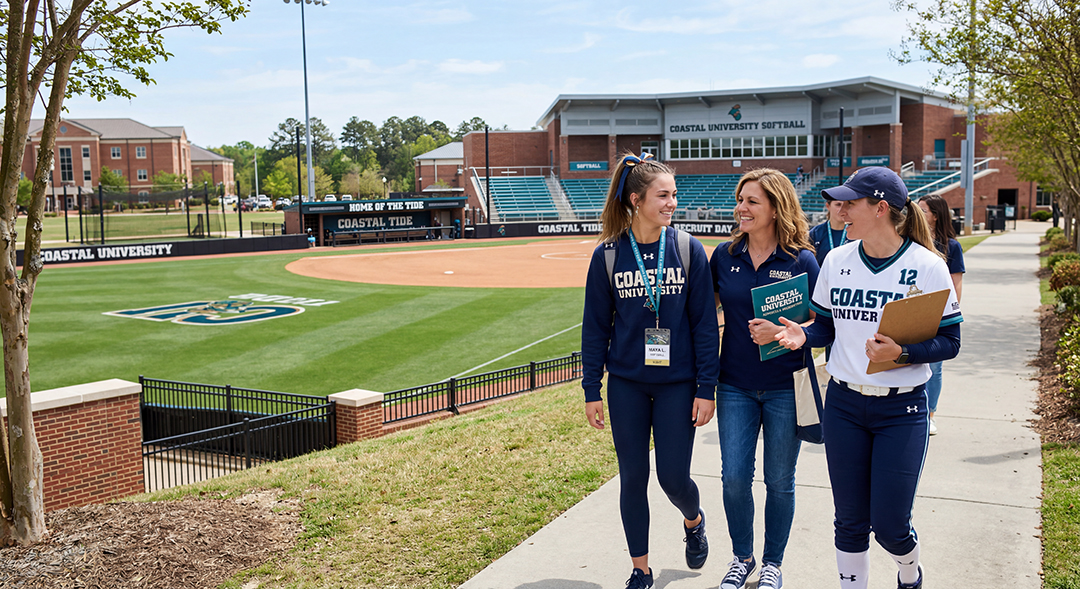
The gap between those two experiences isn’t talent or sophistication — it’s preparation. A campus visit is an evaluation tool, for both sides. The program is evaluating whether your athlete is who they thought she was; your family is evaluating whether the program is what you need it to be. Both evaluations happen at once. The families who understand this arrive ready to run their own.
The two types of visits — what they mean
The official visit
One the program pays for — transportation, housing, and meals for the athlete and, in most cases, her parents. An explicit signal of serious interest: programs don’t fund official visits for athletes they aren’t genuinely considering. Expect a structured itinerary (academics, facilities, staff, players, a practice or game) designed to present the program favorably and to facilitate the genuine evaluation both sides need.
The unofficial visit
One your family pays for, at no cost to the program. Appropriate at any stage and for any program she’s genuinely considering — not a signal of lower interest. These often produce more candid information because the managed presentation is lighter: without the hosts, the structured itinerary, and the athletic dining hall, the campus reveals itself more naturally.
Sequencing: an unofficial visit during the early stages to assess basic fit, then an official visit after a genuine offer when the program is in serious consideration. Taking an official visit to a program you’re unlikely to choose misuses its resources and creates a relational obligation — if it’s not in serious consideration, an unofficial visit gives the campus experience without that weight.
Before the visit — preparation that changes everything
Know what you need to find out
The visit answers the questions film, email, and phone calls can’t. Before arriving, list the specific gaps only an in-person experience can fill — then plan the visit around finding those answers, not around being impressed by facilities.
- What the team culture is actually like when the staff isn’t managing the presentation of it
- How the campus feels on an ordinary day — as a place someone lives, not a structured tour
- What current players say when they’re being honest rather than hospitable
- Whether the coaching relationship in person matches what the phone calls suggested
- Whether her intended academic program has what she needs — faculty, clinicals, employer relationships — or is offered primarily in name
- Whether this is a place she’ll genuinely belong, not just compete
Research what you’re walking into
Know the roster at her position and the competitive dynamics, the academic profile of the school and her program, the program’s recent competitive history, the conference and what it means for schedule and travel, and any recent staff changes. Arrive ready for substantive conversations rather than spending visit time learning basic facts.
Prepare your questions before you arrive
In-the-moment questions are less specific and less useful. The hospitality and excitement conspire to make hard questions feel ungrateful — they’re not. Programs that are right for her answer hard questions directly; those that deflect are providing information too. Write them down, bring the list, use it.
Plan beyond the official itinerary
The itinerary shows what the program wants you to see. Try to arrange: time to walk campus alone, a meal in the main dining hall, time in the academic buildings for her major, an informal player conversation without staff present, and a few hours simply existing on campus. A coach secure in the fit accommodates this; one who isn’t finds the schedule already full.
During the visit — what to pay attention to
Each part of the structure is good for something. Here’s what it’s designed to do — and what to actually look for.
The campus tour
Designed to: show the campus in its best light.
- The campus outside the tour path — study spaces, whether students seem engaged, whether buildings feel alive
- The distance between athletic and academic buildings — a real daily logistics reality
- Whether the campus feels like a place people want to be on an ordinary day
The athletic facilities
Designed to: impress with the program’s investment.
- The practice spaces she’ll actually use — cages, tunnels, weight room — not just the showpiece spaces
- Whether athlete spaces feel clean, personalized, and valued
- The technology and analytics resources, if development tech matters to her
Meeting the coaching staff
Designed to: present the program and assess her.
- How she talks about current players — specific stories and individual knowledge, or the roster in aggregate
- How she handles hard questions — directly, or with deflection and discomfort
- Whether she’s recruiting your athlete or recruiting you — the genuinely interested coach mostly talks to the athlete
- Whether the assistants are present, engaged, and know her film
The academic presentation
Designed to: assure you athletics won’t compromise academics.
- The specifics of athlete academic support — advisors, study hall, tutoring, faculty relationships
- How exam/lab vs. game conflicts are actually handled — ask directly
- The athlete graduation rate (public for NCAA programs); if it’s not mentioned, ask
- Whether her specific program is as strong as claimed — talk to the department, not just support staff
Practice or game observation
Designed to: show the competitive environment.
- How staff interact with players — specific and developmental, or general and demanding
- How players respond to errors — the response to adversity is the real culture
- How the team interacts when staff attention is elsewhere
- Whether she can see herself in this specific environment — not whether it’s impressive
Time with current players
The single most valuable — and most underused — part of the visit.
- Honest answers need the right conditions: small or one-on-one, no staff in the room, players who can be candid
- Ask for unstructured player time; reluctance to allow it is itself information
- Ask for a player’s contact to follow up after the visit, when they’re often more forthcoming (questions below)
The unstructured time
Often where the most revealing information lives.
- Between buildings, informal meals, free time — staff are less managed and players less performing
- How coaches talk to each other, how players treat recruits with no agenda, how campus feels when the guide steps away
The questions your family needs to ask
Organized by who should ask — some belong to the athlete, some to the parents, some to both.
For the head coach
- “For athletes at my position recently, what has a typical four-year arc looked like?” (playing time, asked for history not projection)
- “What does your development philosophy look like for a player at my stage, year by year?”
- “What are the conditions under which an athletic scholarship would not be renewed?”
- “How long do you see yourself at this program?”
- “How do you handle a player going through a difficult stretch — athletically or personally?”
For the assistant coach
- “What drew you to this program, and what keeps you here?”
- “Who is my primary contact once I’m enrolled?”
- “What do you see as my biggest area of development potential?”
For academic advising
- “What’s the actual softball graduation rate over the last four years?”
- “How are travel-vs-academic conflicts handled — especially for labs or clinicals?”
- “What athlete-specific academic support exists, and how do you access it?”
- “How do athletes in [her major] typically navigate the schedule?”
For the financial aid office
Meet separately from athletics — the staff controls athletic money, the aid office controls the rest.
- “What is our Student Aid Index (SAI), and what would the full package look like with our athletic scholarship and this family’s profile?”
- “What academic merit scholarships are available, and at what GPA threshold?”
- “What need-based grants are available, and what’s the process?”
- “Is any institutional aid that athletic-scholarship recipients are excluded from?”
- “What’s the total cost of attendance, including fees not in the scholarship calculation?”
For current players (when honest)
- “What surprised you most when you got here?”
- “What’s the hardest part of being a student-athlete here?”
- “How does the staff handle it when things go badly — a losing streak, an injury?”
- “Is there anything that doesn’t match what you were told during recruiting?”
- “If you were deciding again, would you make the same choice?”
After the visit — processing & follow-up
Write down your impressions immediately
Impressions fade quickly and selectively — the vivid moments persist, the subtle (often more informative) ones disappear first. Within a few hours, each family member writes independently: strongest impression, what surprised you, what was confirmed, what raised an unexpected question, what felt right, what felt uncertain. Then compare — patterns of agreement and disagreement are both informative.
Send the thank-you within twenty-four hours
To the head coach, specific to the visit, warm but not effusive, forward-looking. If it confirmed interest, say so specifically. If it raised questions, you needn’t surface them here — appreciate the experience and address them in follow-up. If it reduced interest, the thank-you is still sent, still gracious; the decision conversation happens separately.
Complete the evaluation before drawing a conclusion
A visit is input into the evaluation, not the evaluation itself. It doesn’t replace the financial analysis, roster assessment, or comparison framework. Integrate the new information — it rarely changes the financial picture, sometimes changes the athletic assessment, and often significantly changes the campus-fit assessment. The visit is the moment to answer what only a visit can answer — not the moment to commit, unless the evaluation was already complete and the visit was the final confirmation.
Follow up on open questions within a week
Every visit produces follow-up questions, promised-but-undelivered information, and questions the visit created rather than answered. Address each within a week, while the context is fresh. This both completes the evaluation and demonstrates the engagement consistent with genuine interest.
What a visit can’t tell you
Worth being honest about — not to diminish the visit, but to calibrate what its information is reliable for.
What the program is like during a hard stretch
You see it at its most hospitable. The culture that determines her experience in October of junior year — when the team is going through something difficult — isn’t fully visible on a curated visit.
What the staff will look like in two years
A staff that’s warm and credible now may not be there when she arrives. Evaluating the institution and the athletic-department support structure — not only the current staff — is the hedge.
How your athlete will grow
The person on this visit at seventeen isn’t the person who’ll be here at twenty-one. The environment that fits her now may become confining — or may make her becoming possible. That uncertainty is irreducible.
What it can tell you, used well: what the program is genuinely like in the ways most visible, what the campus feels like to your specific athlete, whether the coaching relationship matches what the calls suggested, and whether the questions only an in-person experience could answer have been answered. That information is essential — use the visit to get it.
Continue Through Step 7