 Step 7 · Offers & Commit
Making Your Commitment
The process, the paperwork, and what it actually means
The verbal commitment is the moment most families have worked toward since recruiting began — and the one they understand the least. Not the excitement of it. The mechanics: what it is legally, what it isn’t, what documents follow and in what order.
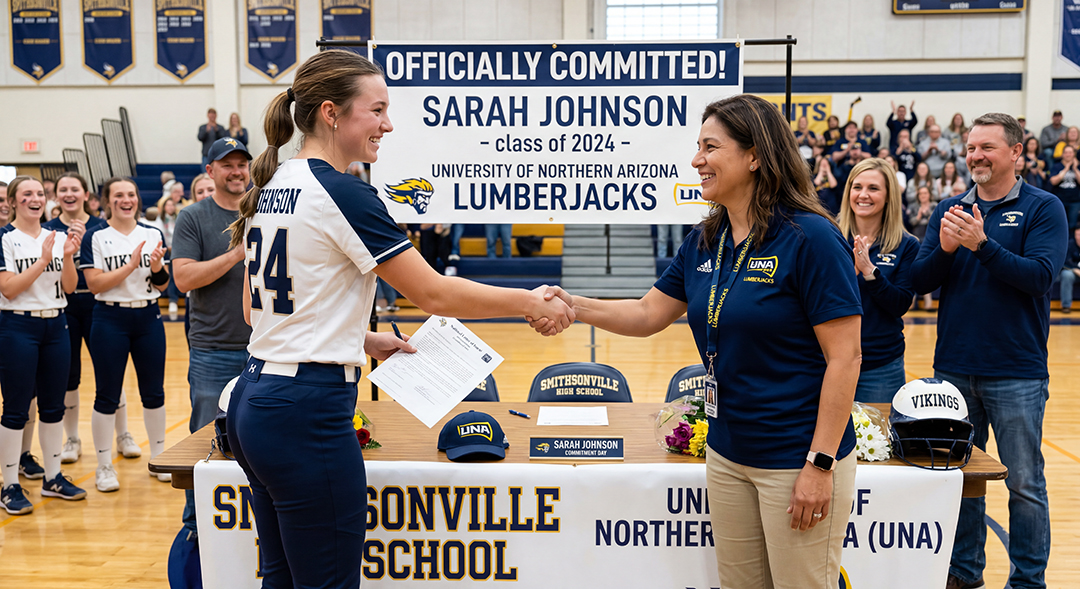
Most families navigate this stage on instinct and goodwill. That usually works out. When it doesn’t — a coach leaves, circumstances change, the scholarship terms turn out not to be what was understood — the families who knew what they were doing are in a meaningfully different position than the ones who didn’t. The goal here isn’t to make the commitment feel like a legal transaction; it’s to make sure the commitment you make is the one you intended to make.
The NCAA eliminated the National Letter of Intent on October 9, 2024. D1 and D2 programs no longer use the NLI as a separate signing instrument — the written offer of athletic financial aid (the financial aid agreement) is now the binding commitment instrument.
If a coach refers to “signing the NLI,” she’s using older terminology — the actual document is the financial aid agreement.
The verbal commitment
The first formal step — and the one most likely to be misunderstood.
What it is
A spoken agreement that she intends to enroll and compete at that school — on a visit, a phone call, any direct conversation. It requires no documentation, no witness, no specific words. The moment she tells a coach yes, a verbal commitment exists.
What it is not
It’s not legally binding on either party. She can decommit without legal consequence; the coach can withdraw an offer or leave without legal consequence. Neither is without relational consequence — both damage trust — but neither creates legal liability. It’s a relationship agreement, honored because reputation and integrity are at stake.
Who to tell immediately
The coach who extended the offer is the first call — clear and direct. Then the coaches at other programs in genuine communication (before the public announcement, not after). Then her travel-ball and high school coaches, who deserve to hear it from her.
The announcement
The public announcement is a near-universal cultural practice and a celebration of a real achievement. A few things worth getting right: time it after the other serious programs have been notified directly; write it in her voice, not as a parent-drafted press release; express gratitude broadly — including the programs she didn’t choose; and never announce before the commitment has actually been communicated to the staff. The announcement follows the commitment — it doesn’t precede it or constitute it.
Maintaining the commitment
The period between the verbal commitment and signing is one of the least discussed stages — and one where the most can go wrong.
The coach is now planning her roster around the commitment, not offering that spot to anyone else, and communicating internally about an incoming recruit. Maintaining the relationship through the signing period isn’t optional etiquette — it’s an obligation: respond promptly, attend events or camps she’s invited to, provide requested paperwork on time, and show up as an invested member of the incoming class. An athlete who goes quiet after the social-media moment makes the coach wonder whether the commitment was real — and that uncertainty leads to conversations that shouldn’t have been necessary.
If circumstances change — decommitting
Withdrawing before the financial aid agreement is signed is permitted, but it carries genuine cost and isn’t a routine option. The difference is whether something genuinely new has come to light, or whether it’s the natural nervousness that attends any major decision.
Warrants decommitting
- A coaching-staff change that fundamentally alters the program she committed to
- A significant change in circumstances — conference reclassification, program discontinuation, a roster change that materially affects her opportunity
- A clear discovery that the commitment was made with significantly incomplete information about something material
Does not warrant it
- A better offer arriving from a more prestigious program
- Anxiety about the decision in the months after
- Social pressure from people outside the family
If it becomes necessary, the conversation happens directly with the head coach — by phone, not text or email, not delegated to a parent. She explains what changed, thanks the coach for the investment, and is honest. The coach may be disappointed; that’s her right. The obligation is honesty and respect, not managing the coach’s reaction.
The financial aid agreement
Sometimes called the athletic aid agreement, scholarship award letter, or written offer of athletic financial aid — the document that formalizes the verbal scholarship offer in writing.
In the post-NLI era (since October 2024), the financial aid agreement is the primary binding instrument that formalizes the commitment — there’s no separate NLI signing on top of it. NAIA uses its own letter alongside the institutional aid agreement; JUCO uses the NJCAA process; D3 awards no athletic scholarships and uses no binding athletic signing document (commitment is enrollment only).
Read it carefully — verify each of these before signing
The exact scholarship amount
The number should match what was verbally offered. Any discrepancy — even small — warrants a direct conversation before signing. Sometimes they’re administrative errors. Sometimes they’re not.
The scholarship type
Grant-in-aid, tuition discount, or a combination? The type matters for how it interacts with other aid your family may qualify for.
The renewal conditions
Terms should be specific. Under post-2025 NCAA House settlement protections, schools can’t reduce, cancel, or fail to renew athletic aid for athletic performance, roster-management decisions, or injury — with specific exceptions (academic ineligibility, fraud, serious misconduct, voluntary transfer, written non-athletic conditions violations). The agreement should be consistent with these.
The duration
Most equivalency-sport awards are one-year, renewed annually; some programs offer multi-year awards for greater stability. The agreement should specify which applies.
What is covered
It should enumerate what’s covered — tuition, fees, room, board, books — and what isn’t, eliminating surprises on the first semester bill.
The institution’s obligations
The agreement creates obligations on both sides. Understanding what the institution has agreed to provide — not just what the athlete agreed to do — is part of reading it fully.
Ask the financial aid office before signing
Separate from the coaching staff — they control athletic money, the aid office controls the complete picture of what you’ll pay.
- What is the total expected cost of attendance next year, including all fees and living expenses?”
- After the athletic scholarship, what additional institutional aid — merit, need-based, other — would we qualify for?”
- Is there any institutional aid that athletic-scholarship recipients are excluded from?”
- What’s the renewal process, and the timeline for renewal decisions each year?”
- If the scholarship amount changes in a later year, what’s the process and the notice period?”
The answers should confirm the net cost you ran during the comparison phase. If they produce a different number, understand the discrepancy before signing.
Formalizing the commitment
NCAA D1 and D2 — the financial aid agreement
Following the elimination of the NLI in October 2024, the financial aid agreement is the formal commitment instrument. When she signs: the institution is obligated to provide the described athletic scholarship for the academic year covered (provided she enrolls and meets the terms); she’s committing to attend for that year; and standard NCAA transfer regulations apply if she later transfers — not the older NLI penalty provisions. It’s signed during the institution’s established offer period, generally aligning with the former NLI windows — November of senior year for early signers, February through senior spring for regular signers.
The agreement is with the institution, not the coach. When she signs, she’s committing to the school — not the coach who recruited her or the assistant who was her primary contact. If the head coach leaves, the institution still must honor the scholarship for the academic year.
What the institution is not obligated to maintain: the informal understandings — the expected role, the playing-time trajectory, the rotation spot, the development philosophy. Those belong to the relationship with the staff and don’t transfer automatically to a new one. The financial protection covers the scholarship; the relationship protections run only as long as the relationship does. This is why evaluating the institution alongside the staff matters.
NAIA — the NAIA Letter of Intent
NAIA continues its own letter of intent, signed alongside the institutional aid agreement, covering one academic year and governed by NAIA rules independent of the NCAA. The principles here apply — read everything, understand it, ask questions — but the document differs.
JUCO — the NJCAA process
NJCAA institutions use their own commitment process under NJCAA rules. The principles are similar — verbal commitment, written agreement, formal signing — but the documents and timing are NJCAA-administered.
NCAA D3 — institutional enrollment
No athletic scholarships and no binding athletic signing document. The D3 commitment is the enrollment commitment — she accepts admission and indicates her intention to participate. Not less serious; the formal mechanism is admission and enrollment rather than an athletic-specific contract.
From verbal commitment to signed agreement
For most who commit in junior year — the common D1 and competitive-D2 timeline — several months pass between the verbal and the formal signature.
Verbal commitment made. The relationship moves from active outreach to maintenance — regular communication, attending invited events, beginning to think about the transition.
Visits may occur (a return to campus in a different context). The pre-signing academic and administrative processes begin.
The program’s academic and financial aid staff start the formal paperwork. Eligibility Center certification should be complete or final; FAFSA and CSS Profile (if applicable) submitted; the award letter reviewed.
The financial aid agreement is signed during the institution’s offer period. The commitment is formally binding. Public announcement (if not already made) is appropriate now.
Enrollment paperwork, housing, academic placement, orientation. The transition from recruit to incoming student-athlete is underway.
Academic eligibility — what must be in place before signing
Eligibility must be established before the financial aid agreement can be signed for D1 or D2. Getting it in place before the signing period arrives is one of the most important pre-signing responsibilities.
The NCAA Eligibility Center — two account types, one is free
Preliminary registration for freshman/sophomore years. Tracks the athlete but does not produce final certification.
$110 domestic, $170 international. Required for D1/D2 before an official visit, signing an aid agreement, or competing. Produces final eligibility certification.
Athletes who qualify by family income (free/reduced lunch, SAT/ACT fee-waiver eligibility, government assistance) can request a fee waiver through the high school counselor. The Profile account can upgrade to Certification at any time; Certification can’t be downgraded. Register the Certification account in junior year, submit transcripts on schedule, and check status regularly — an issue found in October of senior year is harder to fix than one found in spring of junior year. Register at eligibilitycenter.org.
What it evaluates — 16 core courses, by division
D1
Minimum 2.3 core GPA. Standardized tests are no longer required for NCAA initial eligibility (eliminated January 2023, and the old D1 sliding scale is gone). Tests still matter for admission and merit aid at many schools, so most athletes still take them — the NCAA just doesn’t require them for certification.
D2
Minimum 2.2 core GPA. No NCAA test-score requirement.
D3
No Eligibility Center certification required. Eligibility is governed by institutional enrollment standards, which range from academically relaxed to extremely selective.
Course planning: every academic decision from freshman year forward affects eligibility — non-qualifying courses don’t count toward the 16, and core-course grades drive the GPA. Work with the guidance counselor early (ideally freshman/sophomore year) to map a four-year plan that satisfies the core requirements and supports the GPA the target division needs.
NAIA & D3 eligibility
NAIA uses a two-of-three standard — athletes must meet two of: a minimum 2.0 GPA, a minimum standardized test score, or graduation in the top half of the class. Registration with the NAIA Eligibility Center is required before competition. D3 requires no Eligibility Center certification; institutions set their own admission requirements, which range widely — academic preparation still matters.
Before you sign — a final checklist
Run through this before the financial aid agreement (or NAIA letter or NJCAA paperwork) is executed. Every item should be complete.
- D1/D2: Eligibility Center Certification account complete and paid
- NAIA: NAIA Eligibility Center registration complete
- Core-course requirements on track at graduation
- GPA meets the target division’s requirements
- No unresolved eligibility questions remain
- The agreement has been read completely
- The scholarship amount matches what was verbally offered
- Renewal conditions are understood and accepted
- Four-year net cost calculated and confirmed against family capacity
- Academic and need-based aid explored and documented
- A separate conversation with the financial aid office has confirmed the full picture
- All programs in genuine communication have been notified directly
- The verbal commitment was made for the right reasons — genuinely evaluated, not under pressure
- She has read and understands the agreement terms, including renewal and modification provisions
- Regular communication with the staff maintained through pre-signing
- Pre-enrollment paperwork completed on the required timeline
- Transition planning — orientation, housing, academic placement — underway
After signing — what comes next
Signing the financial aid agreement is a milestone, not the end. The short version: maintain the relationship with the staff through enrollment; finish the academic year with the seriousness the opportunity deserves (offers can be withdrawn for significant senior-year academic failures); prepare for the physical demands of college athletics with real intentionality; and arrive on campus in August ready to be a college athlete — not still processing the excitement of a commitment made the previous fall. Everything about making that transition well is covered next.