

Before you sign — the complete pre-commitment checklist
The financial aid agreement is a binding legal document. Once your athlete signs it, they're committed to that institution for one academic year — and recruiting is over. That's not a reason to hesitate. It's a reason to be certain.
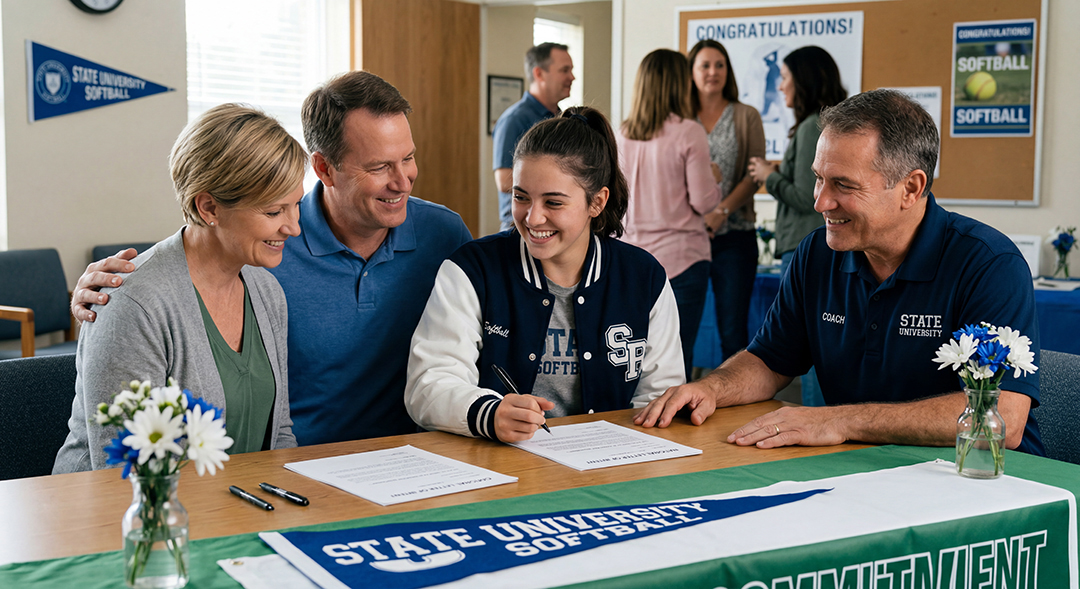
What you're actually signing
The NCAA eliminated the National Letter of Intent in October 2024. NCAA Division I and Division II programs now use a written offer of athletics aid — usually called the financial aid agreement — which serves the same binding function the NLI used to. NAIA programs use their own letter of intent, JUCO programs use the NJCAA commitment process, and Division III uses no binding athletic signing document because D3 offers no athletic scholarships.
Whatever your athlete is asked to sign, ask the coach specifically what the document is, what it commits them to, and for how long.
Work through every section below before signing — or before making a verbal commitment your athlete intends to honor. The families who skip steps here are the ones who discover things they wish they'd known after it's too late to ask.
The campus visit
You can't evaluate a school you haven't seen. Every box checked before signing.
- They have visited this campus in person. Not a virtual tour — an actual visit where they walked the campus, saw the facilities, attended a practice or game, and spent time with current players.
- They spent time with current players without coaches present. The most honest information comes from players living it — at least one unscripted conversation away from staff.
- They asked players the two most important questions. "What do you wish you'd known before you committed here?" and "Would you make the same decision again?" The answers — and the pauses — tell you more than any tour.
- They attended a class or walked through academic buildings. They'll spend most of their time in classrooms, not the locker room.
- The campus felt right in their gut. Ask directly, away from the excitement: "Can you picture yourself here for four years — happy, growing, thriving — even if softball ended tomorrow?"
More on what to observe and what to ask: A Parent's Guide to Campus Visits.
The athletic offer
Get specific. The details of the offer matter as much as the existence of it.
- You know the exact dollar amount. Not "around half tuition" — the specific figure for Year 1, confirmed by the coach or in writing.
- You know exactly what it covers. Tuition only? Room and board? Fees? Books? Transportation? The total picture changes depending on what's included.
- You've asked whether it's renewable — and under what conditions. Ask: "What specifically would cause this to be reduced or not renewed?" and "Has anyone in your program had aid reduced in the last three years, and why?"
- You've asked what happens if they're injured. Does the aid continue during recovery? Who makes return-to-play decisions — a trainer, a team physician, the coach? What is the program's actual history with injured athletes?
- You've asked what happens if the head coach leaves. Your athlete is committing to an institution, not a coach — the written agreement is with the school. Understand the formal protections.
- You understand it's a one-year award, renewed annually. Not a four-year guarantee unless written as one. Know the renewal process — and know what a school is no longer allowed to renew on, below.
- You haven't accepted based solely on the scholarship number. Net cost, academic fit, playing time, coaching relationship, and culture all matter equally. A large scholarship at the wrong school isn't a good deal.
Since August 1, 2024, every Division I school — opted into the House settlement or not — must guarantee athletics aid cannot be reduced or cancelled for athletic ability, athletic performance, contribution to team success, or injury, illness, or a physical or mental health condition.
A bad season is not a permissible reason. Neither is an injury.
At schools that opted into the House settlement, aid may not be reduced, cancelled, or left unrenewed as a result of the new roster limits.
Academic ineligibility, serious misconduct, violating team or institutional rules, or voluntarily leaving the team. These conditions vary by school — which is exactly why they belong in writing before anyone signs.
If a coach answers "we'd have to look at it if you weren't performing," that answer is not consistent with the rule. Ask again, and ask for the conditions in writing.
The financial picture
The scholarship number isn't the whole story. The net cost is.
- You've calculated the actual net cost. Total cost of attendance minus all athletic, academic, and need-based aid — the number that matters, not the scholarship in isolation. The College Cost Comparison Tool confirms whether this school makes financial sense.
- You've requested a financial pre-read. Where the coach brings your financial information to the aid office to estimate institutional aid on top of the athletic scholarship. Ask for it before you commit.
- You've filed the FAFSA. If senior year has begun, it should already be submitted — need-based grants are determined by it, and filing late costs families real money.
- You've compared this school's net cost to at least two others. You can't evaluate an offer without context.
- You understand which parts are free money and which are loans. Scholarships and grants aren't repaid; loans are, with interest. Work-study trades time for money. Never count either as aid.
- You've asked whether athletic and academic aid can be stacked. Many schools allow merit and need-based aid to combine with athletic aid up to full cost of attendance. Ask whether strong academics open additional money here.
- You have a realistic four-year cost estimate. One year of net cost times four, with a 3–5% annual tuition increase factored in. Make sure it's sustainable.
How the money works by division: Understanding Scholarships & Financial Aid.
The athletic fit
Where they fit on the roster, what level they're genuinely matched to, and whether the culture is real.
- You've asked directly where they fit — now and in two years. A coach who genuinely recruited your athlete can be specific about role and development path. Vague "competing for a spot" answers deserve follow-up.
- You know how many players are being recruited at that position in that class. Multiple signings at the same position in the same year means someone's playing-time expectations won't be met.
- You've asked what the first year actually looks like. Limited innings while developing? A real competitive role? Because eligibility now runs on a continuous clock, a quiet freshman year costs a year either way — so it needs to be a deliberate plan you both agreed to, not something discovered in October.
- You've watched the team play and feel the level is a genuine match. Your athlete should compete meaningfully — not overwhelmed, not so far above the level that they stop developing.
- You've asked about culture — and heard something specific. "Can you give an example of how the team handled a difficult loss or a conflict this year?" Specific answers are credible; generic ones aren't.
- You've asked players what the coach is actually like under pressure. Coaches present their best selves during recruiting. Players experience them on a hard Tuesday in October — that's who your athlete is committing to.
Families used to ask about freshman redshirts and medical redshirts. Under the age-based eligibility model the NCAA adopted in June 2026, athletic redshirts and most waivers — including medical hardship — are eliminated for Divisions I and II. Limited exceptions remain for pregnancy, active-duty military service, and official religious missions.
Athletes first enrolling in fall 2027 or later are governed by the new rule only, which includes anyone signing now. The five-year eligibility clock runs continuously and does not pause for sitting out, redshirting, transferring, or injury.
So the useful questions are: what does year one actually look like, and where does the eligibility clock stand for this athlete. Full explanation here.
The academic fit
The institution is a school first. Verify the academic side as carefully as the athletic side.
- The school offers the intended major. Families frequently commit where the major either doesn't exist or isn't available in a softball-compatible format.
- The major is compatible with the travel calendar. Nursing clinicals, education placements, engineering labs and architecture studios run on fixed schedules that conflict with travel. Ask whether current players have completed this major while playing — and to speak with one.
- You've verified the graduation rate for athletes in the softball program. Ask for the right metric: Division I reports a Graduation Success Rate, Division II an Academic Success Rate, and Division III reports neither — so at a D3 program ask how they track it internally. Either way it's different from the overall university rate.
- You understand the academic support available for athletes. Dedicated advisors? Priority registration? Study hall? Tutoring? Travel-conflict policies with professors? The depth tells you how much the program invests in academics.
- They have met with someone in the intended major's department. A real conversation about completing this degree as a student-athlete — during an official visit, before commitment.
The coaching relationship
Four years of being shaped by these people. Make sure it's built on trust, not just enthusiasm.
- They genuinely trust this coaching staff. Not just like them — trust them. Four years of being challenged, developed, and sometimes criticized needs genuine trust as the foundation.
- You've asked the hard question about coach stability. How long has the head coach been here? Where were they before? Known interest elsewhere? Three schools in six years is a different risk profile than a decade building a program.
- You've asked how the staff communicates with athletes and parents. Regular parent meetings? Athlete handles all communication? Neither is wrong — but know the expectation before you arrive.
- You've asked how they handle playing-time decisions. "How do you communicate with a player working hard but not getting the time they expected?" reveals how this coach leads, and whether athletes feel valued off the starting lineup.
- Your athlete asked honestly: does this coaching style bring out my best? Demanding-intense and collaborative-relationship-first are both valid — but the match matters enormously over four years.
The non-athletic life
Most of college doesn't happen on the field. Make sure the rest of the experience holds up.
- They can picture being happy here even if softball ended tomorrow. The single most important question on this page. If the sport is the only reason, they're one injury, coaching change, or surprise away from being somewhere they don't want to be.
- The location works for your family. Distance from home, travel costs to attend games, climate, regional culture — small during recruiting, significant over four years.
- Housing and campus life meet expectations. Where will they live freshman year? Are athletes required to live on campus? What's the social environment beyond the team?
- The alumni network and career resources support the degree. The institution is on their resume for life — does it open the doors they want to walk through at 22?
The process
How the decision gets made matters as much as what the decision is.
- They've had a genuine official visit — not just an unofficial one. Official visits, paid by the school, include structured time with staff, advisors, players, and admissions — qualitatively different from a self-guided tour.
- They are making this decision — not parents, travel coach, or pitching instructor. The people who love them most have opinions and should share them, but this is their life, their college, their four years. The final decision should be theirs.
- They're not committing because of pressure — internal or external. Fear a better offer won't come, fear of disappointing a kind coach, fear of what the travel complex thinks about D2 versus D1 — none are reasons to commit.
- You've taken 24–48 hours after the official visit before deciding. The best decisions are made with a clear head, not in the emotional high of a visit. Go home, sleep on it. If it's still right in the morning, commit with confidence.
- They can say the name of this school with genuine pride. Not relief. Not resignation. Pride. That feeling is a real signal worth paying attention to.
Ask them directly
Let them answer honestly — without coaching from parents, and without a "correct" answer in mind.
"If this program called tomorrow and said the scholarship was no longer available — nothing about the school is changing, just the money — would you still want to go there?"
If yes, this is the right school and the scholarship is a bonus. If no, they need to think carefully about whether they're choosing the school or choosing the offer.
"Four years from now, walking across the graduation stage with your degree — are you proud of where you went and what you built there?"
Let them sit with that image. Does it feel right? Does it feel earned? Does it feel like them?
"Is there anything about this decision you haven't said out loud yet?"
Give them space to answer honestly. Sometimes the most important thing is the one that hasn't been said — a lingering doubt, an unanswered question, a gut feeling that hasn't been named. This question creates room for it.
If all three answers point the same direction — forward, confidently, toward this school — then it's the right decision.
Sign it. Celebrate it. Own it.
This checklist is meant to be worked through carefully, not quickly. The time you invest completing it is small compared to the four years your athlete will spend living the decision it supports.
Keep going
ATHLETESGOING2COLLEGE
STAND OUT | GET NOTICED | GET RECRUITED
The step-by-step college softball recruiting system — six stops from learning how recruiting works to signing with a program that fits. Your athlete runs it, under their own name.
Start the Blueprint — $199/yr →$24.99/month or $199/year · No contracts · Cancel anytime
Recruiting rules change and vary by division. Always confirm current rules with the governing body: NCAA.org · NAIA.org · NJCAA.org