 Coaches Portal · Guide
Teaching Athletes to Own Their Recruiting Communication
The email your athlete sends to a college coach isn’t just an introduction — it’s an audition
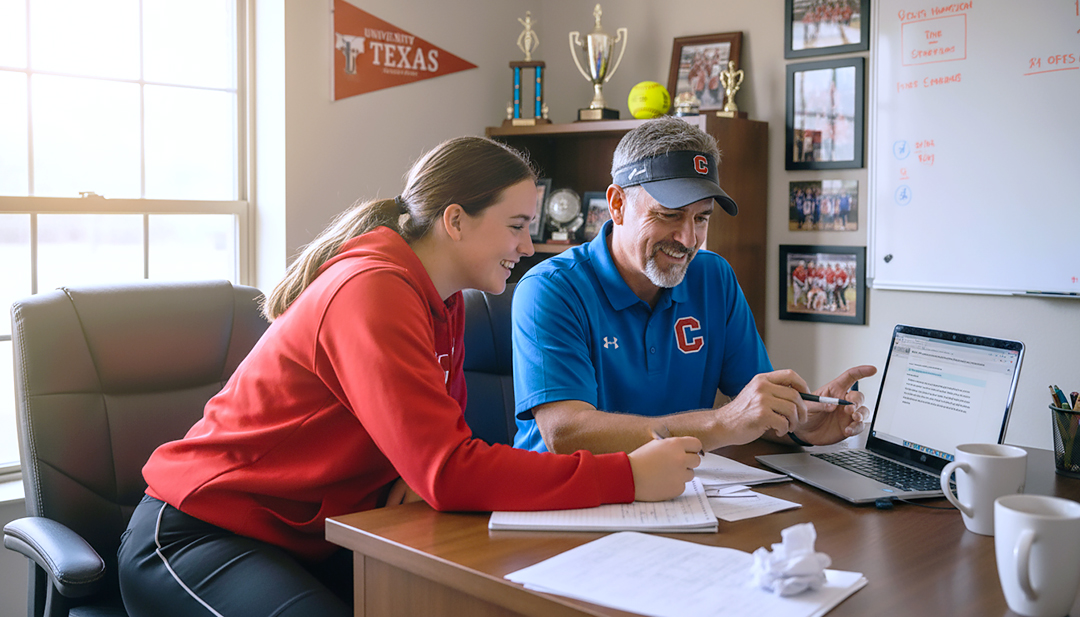
It’s the first evidence a college coach has of whether this athlete can communicate professionally, advocate for herself, and carry herself with the maturity a college program expects. Your job isn’t to send those emails for her — it’s to teach her to send them well.
Why this matters more than most coaches emphasize
College coaches recruit the whole person. This isn’t an aesthetic preference — it affects recruiting outcomes in ways families underestimate.
It affects whether emails get responses
An email clearly written by the athlete — genuine program knowledge, specific rather than generic, reading like a person rather than a template — earns a different quality of attention than one that reads like it came from a committee.
It affects how coaches evaluate her beyond the sport
Three months of well-crafted, consistent communication gives a coach a genuine picture of who she is — and that picture matters when deciding between two athletes whose athletic profiles are comparable.
It affects her development regardless of outcome
Professional communication and self-advocacy are skills she’ll use in college and job applications and professional correspondence for the rest of her life. One of the most genuinely useful things you can teach her.
The coach’s role — coaching communication vs. doing it
The line is easy to cross without realizing it. The athletes who build the strongest relationships communicate directly, consistently, and in their own voice — that voice needs coaching, not replacement.
Your role IS
- Teaching the principles of effective recruiting communication
- Reviewing drafts before they’re sent and giving specific feedback
- Role-playing phone calls and visit conversations so she builds confidence
- Providing the honest information she needs to write credible emails — program knowledge, division context, realistic self-assessment
- Holding her accountable for following up, tracking outreach, and professional standards
- Modeling professional communication in your own interactions with college coaches
Your role is NOT
- Writing emails sent from the athlete’s account
- Telling her exactly what to say in calls with college coaches
- Managing her recruiting correspondence on her behalf
- Contacting coaches in ways that replace rather than supplement her voice
- Editing so heavily the email no longer sounds like a 16-year-old wrote it — it should, just a highly capable, professional one
The foundation — what she needs to know before she sends anything
What she’s actually doing
Not submitting an application — initiating a professional relationship. The email is the beginning of a conversation, not the whole case. Its job is to generate enough interest that the conversation continues.
Why specificity is everything
Every athlete who emails has a video and a stat line. The ones who get responses demonstrate genuine research and articulate specifically why the fit makes sense. “I’m interested in your program” isn’t a recruiting email.
The response — or silence — is information, not a verdict
Silence usually means the roster is full at her position, the timing is wrong, or the level isn’t the match — not “I’m not good enough.” Teach this framework early so she handles non-responses without internalizing them.
Professional standards apply — without exception
Spelling errors, casual language, emoji, text abbreviations, and generic salutations aren’t forgivable as “she’s just in high school.” Coaches evaluate these things. Help her understand what professional looks like first.
Teaching the first email
The most important communication she sends — and the one she’s least prepared to write. Teach the structure first.
The five components, in order
- Who I am — name, grad year, position, high school, travel team.
- Why I’m writing to you specifically — one sentence of genuine program knowledge.
- What I offer athletically — two or three specific qualities, stated plainly.
- What I offer academically — GPA, intended major, NCAA Eligibility Center status.
- What I’m asking for — a clear, specific next step.
Teach her to research before she writes
An athlete who can’t answer three questions about a program before emailing isn’t ready to write the email: What conference do they play in? What was a notable moment from their recent season? How does the academic program connect to something she genuinely cares about? Require these three answers before you review a draft.
Generic vs. specific
“I’ve always dreamed of playing college softball and your program is one I’ve admired for a long time.”
“I’ve been following your program since your run to the Super Regionals in 2024, and I’ve been impressed by how your staff develops pitchers who have multiple quality pitches by their upperclassman years.”
Require a draft, give feedback, have her rewrite — don’t rewrite it yourself. “This paragraph is too generic — tell me three things you know about this program.” “It’s 400 words; a coach reads 150 before deciding to keep going — what can you cut?” The athlete who rewrites her own email three times has learned something. The one who received your edited version hasn’t.
Teaching phone calls — the skill most athletes fear
Anxiety-producing and highly evaluative — a coach who has a strong phone conversation develops a different level of interest than one who only reads emails.
Normalize the anxiety first
“Every athlete is nervous on the first call — coaches expect it. Being nervous isn’t the problem; being so nervous you can’t hold a conversation is what we’ll practice away.” When she knows the nerves are expected, she manages them better.
Teach the preparation ritual
- Know the coach’s name and how to pronounce it
- Three questions she genuinely wants answered
- Two or three recent things about the program
- Profile link ready in case she’s asked
- Quiet location, seated at a table, water nearby
Role-play the call
Call her cell — not face to face — and run a 5–10 minute mock call. Then give specific feedback: full answers or one-sentence prompts needed? Reading from a list or actually talking? Genuine questions? Engaged energy or flat? Repeat until it sounds like a conversation, not a performance.
Teach the thank-you follow-up
Within 24 hours, a brief thank-you email — four to six sentences that thank her for the time, reference one specific thing from the call, reaffirm interest, and provide anything she was asked for. Non-negotiable.
Teaching campus-visit communication
The highest-stakes communication opportunity in recruiting — teach her to show up as a communicator, not just an athlete being evaluated.
Before the visit
Prepare genuine, research-based questions — the quality of her questions tells a staff as much as her answers. “What’s the team culture like?” is what every recruit asks; “you’ve graduated four seniors from the rotation — how do you approach rebuilding pitching depth, and what does that mean for my class?” demonstrates research. Require at least five; review them beforehand.
During the visit
Teach her to lead conversations rather than respond to them — full answers, thoughtful follow-ups, genuine eye contact. Specifically: don’t look at parents before answering. Deferring to a parent’s expression signals dependence rather than the independence coaches are evaluating.
After the visit
Within 24 hours, a specific, genuine thank-you — not a template. A real reflection of something that stood out (a conversation with a player about balancing academics and travel that addressed a real question). Specific, genuine, actionable emails get responses; generic ones get filed.
The follow-up system — consistent without being annoying
A common mistake: going quiet between initial contact and commitment conversations, and the relationship goes cold. Teach consistent, value-add contact.
Think of every follow-up as an update, not a reminder. “I’m still very interested” gives the coach nothing. “I pitched 11 innings across three games at the Fall Classic, posted a 0.82 ERA, and struck out 14 against the strongest competition I’ve faced” gives her a reason to pay attention.
A sustainable rhythm after a positive response is once every three to four weeks during active recruiting, timed around events with new performance content. More risks becoming noise; less risks losing the thread. Teach her to keep a simple log — which coaches, when, and the response — so she doesn’t over-contact some and go silent with others.
Teaching the difficult conversations
Situations that carry emotional weight and that athletes aren’t naturally prepared for. Tap each to expand.
When a coach makes an offer
Teach her that the right response is enthusiastic gratitude plus a request for time to review with her family — not an immediate yes or no. Many athletes say yes too quickly because they don’t know they’re allowed to ask for time. Teach them they are.
“This means so much — I’m genuinely excited about this program and I need a few weeks to discuss it fully with my family. Can I get back to you by [specific date]?”
When a coach goes quiet after expressing interest
Emotionally difficult — athletes often go completely quiet themselves or over-contact in a way that creates pressure. Teach one follow-up, after a reasonable silence, that updates with recent content and gently confirms interest. If there’s no response after that, the relationship has likely run its course — information, not rejection.
“I wanted to update you on this past weekend’s results and let you know [School] remains high on my list. I’d welcome a chance to reconnect whenever timing works for you.”
When a coach asks directly about interest level
Not a trick question — a practical one about allocating recruiting resources. Teach her to answer honestly and specifically, which is better than falsely claiming it’s the top choice or being so noncommittal the coach can’t calibrate.
“This program is genuinely one of my top choices, and here’s specifically why…”
When a program she’s verbally committed to is calling
Teach athletes who’ve made a verbal commitment that they’re still responsible for managing that communication professionally — following up, answering questions, demonstrating continued interest — until the financial aid agreement is signed. A verbal commitment that goes quiet on the athlete’s end sends a message she doesn’t intend to send.
The hardest teaching moment
There will be moments when an athlete shows you a draft that’s genuinely not ready — generic, error-filled, below the standard the program deserves. The temptation is to fix it quickly and move on. Resist it. The email that gets fixed without teaching her why produces one better email; the conversation that explains what wasn’t working, sends her back to rewrite, reviews the revision, and finally signs off on a third draft produces a more capable communicator.
“This isn’t ready to send yet. Here’s what’s not working and why. Revise it and come back to me — we’re not sending this until it represents you the way you’re capable of being represented.” That conversation takes longer. It’s also the one that develops her.
Before she begins recruiting — a readiness checklist
- She can write a clear, specific, error-free introductory email to a program she has researched
- She knows the five components of an effective intro email and can produce them without a template
- She can answer three questions about any program before contacting it
- She can hold a ten-minute phone conversation with an unfamiliar adult without prompting or deferring to parents
- She has three to five genuine questions ready for any visit or call
- She knows what a follow-up email is and when to send one
- She can distinguish value-add follow-up from generic checking-in — and consistently produces the former
- She maintains a log of every coach contact, when, and the response
- She handles non-responses as information rather than rejection
- She has sent at least one email independently — researched, drafted, reviewed, revised, sent in her own voice — before active outreach
If she can’t do all of these, she isn’t ready to recruit — she’s ready to be coached. That’s what you’re here for.
Keep building your recruiting toolkit