

The recruiting conversations playbook
Scripts for the conversations coaches actually have to have.
Nobody prepares you for these. The clinics cover defensive positioning; the certifications cover safety and eligibility. Nobody sits a travel coach down and says: here's what to say when a family is convinced their athlete is a D1 prospect and the honest answer is she isn't — or when an athlete is thinking about quitting and hasn't told anyone but you.
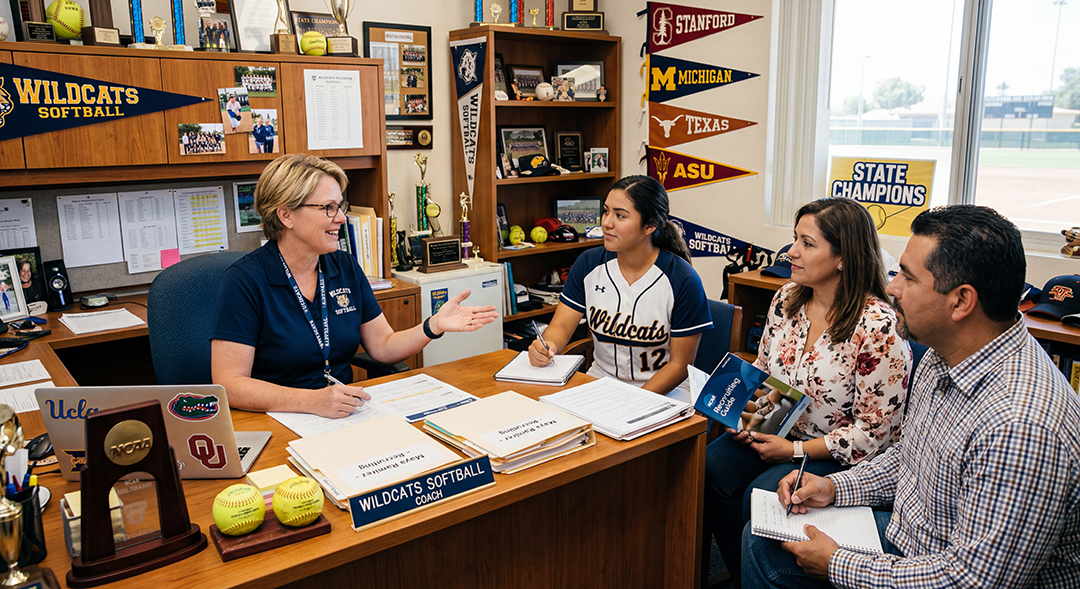
Structure, not speeches
Each conversation follows the same shape: the situation, what not to do, the opening, the body, how to close, and what to do if it goes sideways. The scripts are starting points — your voice should be different. What's here is the structure, the sequencing, and the language patterns that work because they're honest, direct and protective of the relationship at the same time.
Say the hard thing early.
The temptation is to warm up with positives and slip the hard part in at the end. But then the person spends the warmup waiting for it, and when it lands it feels like a reversal.
Say it early, deliver it with care, and spend the rest of the conversation on context, support and the path forward.
The situation A family is fully invested in a D1 future and has spent years and significant money on that expectation. Their athlete can compete — but honestly she's a D2 or D3 player, and every month pursuing the wrong level costs time on the right one.
What not to do Keep sending her to D1 showcases hoping something changes. Avoid the conversation. Soften it so much it doesn't land. Compare her to teammates.
"I want to have an honest conversation about [Athlete's] recruiting, because I think it's time and you deserve my real assessment rather than a comfortable one. Is this a good time?"
"The D1 athletes in her grad year at her position are [specific comparison]. [Athlete] is currently at [honest level]. That gap is real and it matters to D1 coaches.
What it does not mean: that she can't play college softball, or that her work is wasted. It means the level where she'll be genuinely recruited — real scholarship money, real playing time — is more likely D2 or D3 right now. And those levels are excellent: programs where she'll compete, develop, start, and have a college life that's exactly what she wants.
The cost of pursuing D1 exclusively is time. Every month emailing programs that won't offer is a month not building relationships with programs that will."
"Let's build a target list with realistic D2 and D3 programs where I genuinely believe she's a strong candidate. And I'll keep it open — if I see specific measurable improvement in [skill] by [timeframe], I'll tell you and we'll revisit this together."
"I respect that you see her differently than I do. Let's agree on a measurable standard: tell me what you believe she can do, and let's watch her against D1-calibre competition at [event] and evaluate together. I'm open to being proven wrong — I just want decisions based on what we actually see."
The situation Different from the family conversation — you're her coach, her advocate, and a trusted relationship. The goal is honesty that preserves the relationship and motivates rather than devastates.
What not to do In front of teammates. Mid-tournament or right after a poor performance. Comparisons to others. Sugarcoating past the point of being received.
"Can I grab a few minutes one-on-one? Not about anything you did wrong — I want to talk honestly about your recruiting, privately."
"I'm going to tell you something honest because I respect you too much to tell you something comfortable. The recruiting feedback isn't reflecting D1 interest the way you've been expecting.
Here's what I observe: [two genuine strengths]. Here's the harder part: [one specific gap affecting D1 recruitment]. That's not to discourage you — it's because you can do something about it and you need to know exactly what it is.
The market is showing D2 and D3 are where real interest will come, and that isn't a smaller version of your dream. If you want to prove me wrong and close that gap, I'll be the first in your corner — tell me and I'll show you exactly what that path looks like."
"What's your honest reaction — not the answer you think I want, the real one?"
Then wait. What she says tells you what the next conversation needs to be.
The situation A parent wants you to reach out to a genuine mismatch. Their expectation is that your name opens a door. Your concern is that it closes one — your credibility with that program.
What not to do Agree and then fail to send it. Send a halfhearted email. Avoid the parent. Argue about the athlete's level in the same conversation — keep those separate.
"I want to talk about the email to [program]. I'll be honest about why I'm hesitant, because you deserve the real reason rather than a runaround."
"When I reach out to a college coach for an athlete, that coach trusts I've vetted the match honestly. If I send an email about [Athlete] to [program] right now, the coach watches her film, sees the level isn't a match, and loses confidence in my recommendations going forward — which affects every athlete I advocate for there.
What I'm willing to do is reach out where I genuinely believe the fit is real, so my word means something. The programs I believe are genuine fits are [alternatives], and I'll make real introductions there."
"I'm not declining because I don't believe in her — I'm declining because sending an email I can't stand behind would hurt her more than help. My name carries weight when it's used carefully. The most useful thing I can do for her is protect the credibility that makes my advocacy actually work."
The situation A family expecting a significant scholarship isn't getting one. They need the financial reality in time to plan for it.
What not to do Avoid it because it feels like it isn't your place. Wait until senior year. Oversimplify — the full picture is more nuanced than athletic scholarship numbers alone.
"I want to have a direct conversation about the financial side of [Athlete's] recruiting, because there are things worth understanding clearly and now is the right time."
"Softball is an equivalency sport. Under the House settlement, D1 schools that opt in can fund up to 25 scholarships, while schools that don't opt in remain at the traditional 12 equivalencies divided across the roster. Either way, full rides are rare — most athletes, including legitimate D1 recruits, receive partial offers.
Based on what I'm seeing, realistic offers for [Athlete] look like [honest description — partial D2 offers, or D3 programs offering academic merit aid without athletic scholarship].
Look at the full picture rather than the athletic number. Many D3 schools offer substantial, stable academic merit aid, and D2 programs often allow academic aid to stack on top of athletic. The number that matters is net cost — what your family actually pays after all aid. A D3 athlete with strong academic aid can sometimes pay less out of pocket than a D1 athlete on a partial."
"I'm not saying this to discourage you — the best financial outcomes go to families who do the maths early. I'd point you at the College Cost Comparison Tool to put schools side by side on real net cost, and I'm happy to walk through specific programs together."
The situation An athlete who used to be first to practice is going through the motions. Present but not invested. You're not sure whether it's burnout, something harder, or something she needs to name before you can help.
What not to do In front of the team. As a performance conversation. Starting with what you need from her. Diagnosing it before she's told you what's happening.
"Hey — do you have a few minutes? Just you and me, no agenda, I just want to check in."
Find a genuinely private moment. No distractions, no clipboard.
"There's no right answer here and I'm not evaluating you. I've been watching you and something feels different lately — not wrong, just different. Do you know what it is?"
Then stop. Wait. Don't fill the silence.
"You don't have to have an answer now. How are you actually feeling about softball right now — not what you think you should feel?"
"That makes sense. Is it your body, your head, or both?"
"That takes courage to say. Is it the sport, or something specific about this situation?"
"Whatever you decide, I'm on your side — I won't pressure you to stay. Will you give yourself a week of just noticing how you feel when you're not playing, and talk to your parents before you decide?"
"However this unfolds, my job is to be in your corner. That doesn't change based on whether you play softball. You're not just an athlete to me — you're a person I've invested in, and that doesn't expire when the season ends."
You are her coach, not a clinician. Your job in this conversation is to listen and to connect her to support — not to assess what's wrong or to handle it yourself.
- Don't promise confidentiality before you've heard what she says. If you promise it and then have to involve someone, you've broken trust at the worst possible moment. "I'm always going to do what keeps you safe" is honest and holds up.
- If anything she says points beyond tiredness — hopelessness, self-harm, not wanting to be here, or anything that worries you — connect her to her parents and her school counsellor the same day. Not next week. Not after the tournament.
- If you're concerned about immediate safety, don't leave her alone, and involve her parents right then.
- The 988 Suicide & Crisis Lifeline can be called or texted at 988, 24 hours a day, by her or by you if you need guidance on what to do next.
- You don't need to be certain to act. Raising a concern that turns out to be nothing costs almost nothing. The other error is not recoverable.
The situation A parent is writing emails in the athlete's name, contacting coaches independently, and leading visit conversations — creating an impression that the athlete can't advocate for herself. Coaches are noticing.
What not to do In a group setting. As a criticism of character. Using the word "overinvolved". Implying coaches have complained — even if they have.
"I want a private conversation about [Athlete's] recruiting — can we find fifteen minutes this week, somewhere we can actually talk?"
"I know how invested you are in her, and everything you're doing comes from that. I respect it.
Coaches are specifically watching whether an athlete can advocate for herself — initiate communication, manage relationships, handle adult conversations professionally. When that communication comes primarily from a parent, coaches conclude, unfairly but really, that she may not be ready to navigate college without heavy parental involvement. That can affect whether they pursue her even when they're interested athletically.
The thing most likely to help her is letting her be the one who communicates. Your job is to be her support system — proofread, help her prepare, attend visits as an observer.
I'd ask you to try something specific: for the next thirty days, every piece of recruiting communication comes from her account, in her words. You can review it first, but she sends it. Can we agree on that?"
"I'm not criticising what you've done — I'm saying it because I believe it changes the outcome for her. What can I do to make it easier to step back in a way that still feels like you're supporting her?"
The situation She's excited to commit somewhere you believe is a significant mistake — wrong level, red flags she didn't notice, or a decision made from anxiety rather than conviction. And she's asking your input.
What not to do Tell her what to do. Validate a decision you believe is wrong. Or be so cautious you fail to say what you think — she asked.
"You asked what I think, so I'm going to tell you honestly. Is that still what you want?"
"Here's my honest reaction: [specific concern — the vague answers to your playing-time questions and the deflection about roster plans concerned me] or [I think you're committing to end the uncertainty rather than because this is the right school].
Before you call that coach, answer one question honestly — for yourself, not for me. If you couldn't play softball, would you still want to go to this school?
If yes, I'll be the first one at your signing. If no, or you're not sure, there's more to explore."
"Then I support you and I'll help you make the most of it — the decision is yours. What I ask in return is that you complete the Before You Sign checklist first, so you can say you went in with your eyes open."
The situation A hard-working, deserving athlete isn't getting opportunities. Programs aren't responding, interested coaches have gone quiet, and the commitment posts in her feed are amplifying it. She hasn't said most of this out loud, but you can see it.
What not to do False reassurance — "your offer is coming, just wait". Minimising the difficulty. Making it a performance conversation. Comparing her to athletes who found programs.
"How are you doing with all of this — honestly?"
And then be quiet.
"What you're feeling makes sense. This process asks you to put yourself out there and wait for people who don't know you to decide whether you're worth their time.
The silence doesn't mean what you think it means about who you are. Timelines differ, roster needs change, programs fill positions before they reach your division. I've watched athletes who couldn't get a response in the autumn get two offers before spring signing.
What I want to work on is the list — whether we're targeting the right programs at the right levels. Sometimes silence means the answer isn't more emails into the same inbox, but adjusting the list toward places that will actually say yes. Can we look at it together?"
"Something that isn't about recruiting: I've watched you work, show up when it was hard, and compete when nothing was going right.
The discipline and persistence you're building aren't wasted if the outcome isn't what you expected — they're the foundation of everything you'll do for the rest of your life. I need you to believe that, because it's true."
The situation She has the athletic profile to attract interest but academic problems — GPA, core courses, eligibility centre registration — that will close doors before coaches can open them. The family doesn't fully understand the severity or the timeline.
What not to do Wait until it's irreversible. Make it about her intelligence. Let the family leave thinking it'll work itself out.
"I want to talk about what I think is the most urgent issue in [Athlete's] recruiting right now — and it isn't athletic. It's academic, and it needs immediate attention."
"NCAA eligibility is specific: 16 core courses, a minimum core-course GPA — 2.3 for D1, 2.2 for D2, with D3 setting its own academic standards — and registration with the NCAA Eligibility Center. Standardised tests are no longer required for NCAA eligibility, and the old sliding scale was eliminated, though tests still matter for admission and academic merit aid.
A coach can be interested and have money available, and still be unable to offer a scholarship to an athlete who won't be eligible to compete.
Here's where [Athlete] stands: [core courses completed and remaining, current GPA against the minimum, eligibility centre registration]. If nothing changes: [specific consequence]. Here's what needs to happen now: [courses to take, counsellor to meet, eligibility centre to contact]. I'll help you navigate it, but the family and the school counsellor need to drive it."
"I'm telling you now because there's still time to fix it if we start immediately. I'd rather have this conversation today than tell you in her senior year that the offer couldn't be formalised. Please make an appointment with her guidance counsellor this week."
The situation She's reached the end of the process without an offer. The window is closing, or has closed. She and her family need help processing that and moving forward with their heads up.
What not to do Keep sending her to showcases on false hope. Avoid it until it's undeniable. Frame it as failure. Compare her to teammates who found programs.
"I want to have an important conversation with you — and your parents if you'd like them here — about where things stand. I want to do it honestly and with care."
"We're at the point where the realistic opportunities to play at the levels you've pursued are very limited, and you deserve that honesty more than false hope.
I know what this has cost you and your family in time, money and years of effort. None of that is erased by this outcome — the discipline and competitive character you've built are yours, and they go with you into everything next. Not playing college softball is not the same as not succeeding.
There may be D3 walk-on opportunities worth exploring, or club softball at whatever college you attend. And there's an entire college experience ahead that has nothing to do with this outcome.
What do you need from me right now?"
Every conversation here is a version of the same thing: telling the truth in a way that keeps the relationship intact and opens a path forward.
That's harder than it sounds. It takes professional confidence, emotional resilience, genuine care for the people in front of you — and the willingness to be the one who says the hard thing when everyone in the room would prefer you didn't.
The coaches who do this well are the ones whose athletes find the right programs, whose families trust the process, and whose reputations are built on something real. That's what this playbook is for.
Keep building your toolkit
ATHLETESGOING2COLLEGE
STAND OUT | GET NOTICED | GET RECRUITED
The step-by-step college softball recruiting system — six stops from learning how recruiting works to signing with a program that fits. Your athlete runs it, under their own name.
Start the Blueprint — $199/yr →$24.99/month or $199/year · No contracts · Cancel anytime
Recruiting rules change and vary by division. Always confirm current rules with the governing body: NCAA.org · NAIA.org · NJCAA.org