

Understanding the college softball recruiting landscape
Before you send a single email, build a profile, or attend a showcase — understand the world you're entering. More complex, more competitive, and more navigable than most families realize. This is the complete picture.
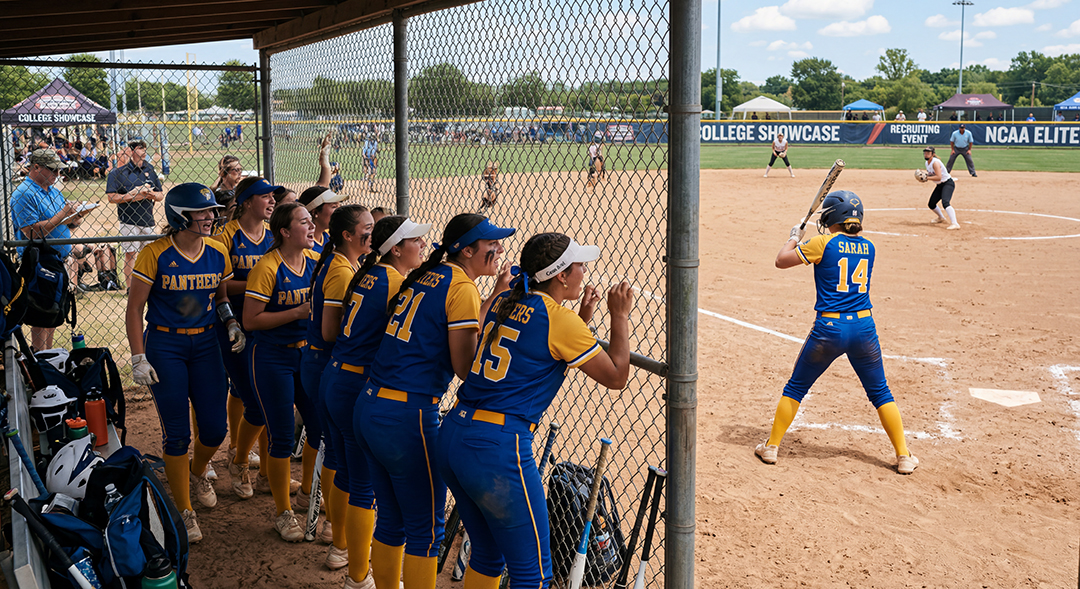
What the landscape actually is
College softball recruiting isn't one system with one set of rules. It's a collection of distinct governing bodies — each with its own scholarship structure, academic requirements, and recruiting calendar — that together define the full range of opportunities for a college softball player.
Families who skip this foundation and jump straight into action make the same preventable mistakes: pursuing the wrong division, emailing the wrong programs, paying for the wrong showcases, and misreading the signals the market sends. Spend the time here. Everything that follows works better because of it.
Where college softball is actually played
The most visible and competitive level — the Women's College World Series is a D1 event. Under the House settlement, programs that opt in can fund up to 25 softball scholarships alongside a 25-player roster cap, replacing the old 12-equivalency limit; non-opt-in programs remain at 12. Full rides still go to a small number of elite recruits, and many awards remain partial.
A high level that's consistently undervalued. D2 offers genuine scholarship support and often more playing time and development than the margins of a D1 roster. Electronic contact can begin anytime. When academics also qualify for institutional merit aid that stacks on the athletic award, D2 frequently produces better overall outcomes than a marginal D1 option.
The most academically rigorous environment in college athletics — and the most underestimated. No athletic scholarships, but D3 schools frequently offer academic merit and need-based aid that produces net costs lower than D1 programs with partial athletic awards. Recruiting here is the most flexible: D3 doesn't operate on the NCAA recruiting calendar at all.
Four-year institutions outside the NCAA structure — more scholarship room than D2 and the most flexible recruiting rules of any body. Often lower costs of attendance, so scholarship dollars stretch further. Not a consolation option: for the right athlete, NAIA is a competitive, scholarship-supported experience that can beat the margins of NCAA programs.
Two-year programs that serve real strategic purposes — an academic reset, two years of athletic development before transferring, or the most realistic financial path. NJCAA D1 can fund up to 24 scholarships, more than D2 or a non-opt-in D1 program. Athletes who perform well often transfer to four-year programs, sometimes at higher levels than were available out of high school. Not a lesser path — for some athletes, the right one.
Calibrate, don't panic
These numbers aren't meant to discourage — they're meant to calibrate. The market is inefficient: programs at every level are actively looking for athletes who fit specific needs — the right position, graduation year, academic profile, and region. The athlete who targets the right programs with the right outreach consistently outperforms one who's simply talented but not strategic. Strategy matters more here than most families realize.
Figures are approximate and rounded. Independent estimates put the all-division rate near 7.8% and the D1 rate near 1.6%. For current official numbers by sport, see the NCAA's Probability of Competing Beyond High School, which is updated annually.
The honest division conversation
Before you build a target list, begin outreach, or attend a recruiting showcase, you need an honest answer to one question: what division level is realistic right now, and what would need to change for that picture to look different? This isn't about aspiration — it's about where the athlete's profile is genuinely competitive for offers and real consideration today.
The most reliable source is a direct, specific conversation with an experienced coach who has watched them compete and will tell the truth. Ask the travel coach: "What level are they realistically competitive for right now, and what specifically would need to develop to change that?" Push past general encouragement into specific assessment — benchmarks, current standing, a realistic development timeline. That conversation is worth more than any showcase or platform.
Choosing the Right Division walks through the five questions that actually determine fit.
When things happen
A grade-by-grade overview. The full recruiting timeline covers each stage in detail, along with the NCAA contact rules and the current calendar.
Build the academic foundation, register with the NCAA Eligibility Center, find the right travel-ball environment, and learn the landscape. Don't begin active outreach yet.
Note: under the age-based eligibility model adopted in June 2026, the five-year clock can start on a 19th birthday rather than on enrollment — which means reclassing or a post-grad year may now cost a season. Read the full explanation →
Have the honest division-level conversation, start building the profile, and research programs at realistic levels. D2 and D3 coaches can begin direct contact well before D1 is permitted to.
The most important evaluation window for D1 athletes. Coaches attend summer showcases to identify athletes they'll contact on September 1. Be ready: profile current, competing at the right events, performing at a level that generates interest.
September 1 is the D1 coach-contact date. Before it arrives, have a complete profile, a working target list, and a ready outreach email. Outreach, visits, and real coach relationships develop through the year — the core of the process.
Evaluation is largely complete. Visits narrow to serious options; financial packages are compared; the commitment is made on complete information. For D1, commitments are finalized through the institution's athletics financial aid agreement rather than the National Letter of Intent, which was discontinued in 2024.
Six things, in roughly this order
The baseline measurables — velocity, exit velocity, pop time, 60 time, range, mechanics — that determine whether a player belongs at a given level.
The trajectory. A projectable freshman with coachable mechanics is sometimes more attractive than a fully developed senior whose ceiling is already visible.
Not just eligibility — actual quality. A 3.5 opens doors a borderline 2.4 doesn't, and strong academics unlock merit aid that improves a program's financial offer.
How they respond to feedback and adversity, how they treat teammates, dugout presence when things go badly. Coaches actively watch this at showcases.
A program set at catcher isn't recruiting catchers, regardless of quality. Fit is about timing — why the same athlete gets interest from some programs and silence from others.
Some coaches recruit to a specific system or culture. Understanding what a program values beyond generic criteria is part of recruiting strategically.
How the money actually works
Softball has traditionally been an "equivalency" sport — a set number of scholarships split across the roster as partial awards. That's still how D2 (7.2), NAIA (up to 10), and NJCAA operate. D1 changed under the House settlement: programs that opt in can now fund up to 25 scholarships under a roster-limit model. Not every program opted in, and many awards stay partial — so net cost still varies widely.
Total cost of attendance minus all aid — athletic, academic, and need-based — is what you actually pay. A 40% award at a $32,000 school and a 25% award at a $65,000 school produce very different net costs. Compare net cost, not scholarship percentage. The College Cost Comparison Tool runs it side by side.
At D3 and many D2 schools, academic merit aid can be the largest single source of support. A 3.7 GPA recruit may qualify for merit awards larger than any athletic scholarship at that level. Research this at every school under serious consideration.
Federal aid and need-based institutional grants require a FAFSA. File as early as possible — around October of senior year — to access everything available.
Who can contact whom, and when
There are no restrictions on athlete-initiated communication, at any level, at any time — including emailing a D1 coach before September 1 of junior year. The limit is on the coach's ability to respond with recruiting communication, not on your ability to reach out.
A hard rule with compliance consequences. A D1 coach who responds to a pre-junior athlete with recruiting communication is violating NCAA rules — so silence before September 1 isn't a verdict on the athlete.
D2 coaches can initiate contact anytime; D3 essentially year-round and outside the NCAA calendar entirely; NAIA has no restrictions. Athletes targeting these levels should be making direct contact earlier in the process.
The full rules — contact, evaluation, quiet and dead periods, official and unofficial visit windows by division, and the current softball calendar — are on the recruiting timeline page.
How evaluation actually happens
They attend events to assess players they know about — not to discover unknowns by accident. The athlete who did outreach before the event is evaluated differently than the unknown beside them.
A national D1 showcase before a profile is competitive at that level is expensive exposure where the coaches present aren't evaluating at the athlete's current level. Quality of competition beats volume of events.
Coaches watch video before reading anything. A reel that doesn't start strong loses them before the compelling content. Keep the profile specific, current, and academically complete — specifics stop the scroll.
Three things to hold onto
This is the athlete's process. The athlete who writes their own emails, makes their own calls, and leads their own visit conversations arrives at college knowing they got there themselves — and is at a systematic advantage over one who waits to be found.
Coaches trust honest, specific communication and distrust managed, optimistic communication. They don't have to be perfect — they have to be real.
Non-responses, coaches who go quiet, offers that don't come at the expected level — these are information about a specific market at a moment in time, not verdicts about anyone's worth. The right school exists for the athlete who approaches this honestly and strategically.
Before you move on, make sure each of these is true
- They understand what each governing body offers and which are realistic targets for their current profile
- They've had an honest division-level conversation with their travel coach and know where they're genuinely competitive
- They understand the financial basics — how scholarships work by level, what net cost means, and why merit aid matters
- They understand the communication rules — what they can do, what coaches can and can't do, and why September 1 matters for D1
- They understand what coaches actually evaluate and can honestly assess their own profile against it
- They're ready to own this process
If all of that is genuinely in place, you're ready for the next decision. If any of it is uncertain, address it now — before the strategy is built on a foundation with gaps in it.
Next: choosing the right division
ATHLETESGOING2COLLEGE
STAND OUT | GET NOTICED | GET RECRUITED
The step-by-step college softball recruiting system — six stops from learning how recruiting works to signing with a program that fits. Your athlete runs it, under their own name.
Start the Blueprint — $199/yr →$24.99/month or $199/year · No contracts · Cancel anytime
Recruiting rules change and vary by division. Always confirm current rules with the governing body: NCAA.org · NAIA.org · NJCAA.org