 Coaches Portal · Guide
How to Write a Scouting Report for Your Player
A coach’s guide for college recruiting profiles
A scouting report from you is the one piece of recruiting content that can’t be faked, can’t be assembled from a highlight reel, and can’t be produced by anyone other than someone who has actually watched this athlete compete. That’s why it matters so much — and why most coaches write them badly.
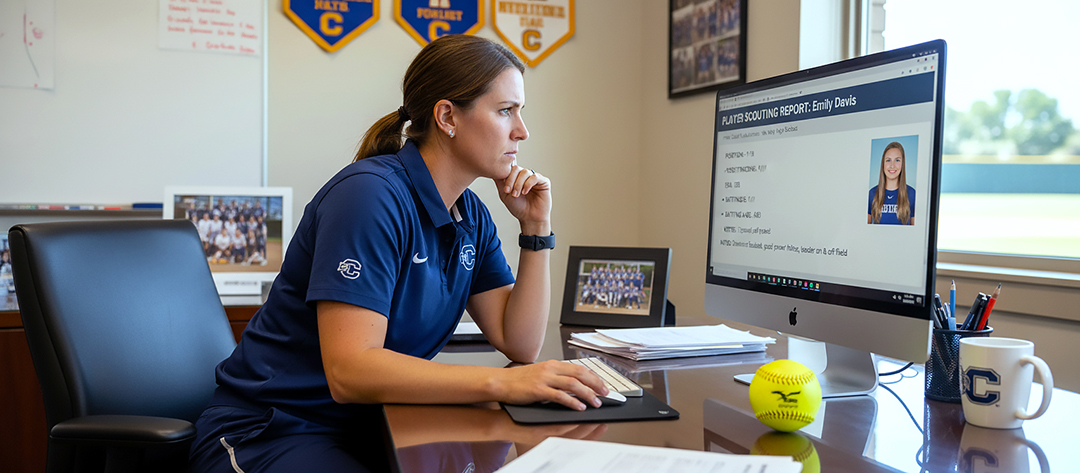
The typical coach scouting report is two paragraphs of superlatives — great teammate, hard worker, high character — followed by a stat line the college coach could have found herself. It tells her almost nothing useful, and it signals that the coach writing it either doesn’t know the athlete well or doesn’t understand what college coaches are actually trying to learn.
A well-written report tells a college coach something she can’t get anywhere else: a specific, honest, firsthand account of what this athlete actually does and who she actually is. That kind of report opens conversations nothing else opens — and builds the trust between travel coaches and college coaches that produces sustained recruiting relationships.
What a scouting report is — and is not
It’s a professional evaluation document — an honest, specific, firsthand assessment of an athlete’s current ability, development trajectory, and character from someone who has observed her directly in competition. It is not a testimonial designed to make someone feel good, and it’s not a marketing piece. College coaches recognize promotional language immediately and discount it; a report that reads like an advertisement tells a coach the writer either lacks genuine insight or won’t share it.
The test for a good scouting report: does it tell a college coach something she could not find anywhere else? If everything in it is already in the profile stats and the highlight video, the report hasn’t done its job.
When to write a scouting report
Most appropriate at three moments in the recruiting process.
As part of a cold introduction
Reaching out to a coach on behalf of an athlete with no existing relationship: a brief two-to-three-paragraph scouting summary embedded in your introduction email gives immediate context for why you’re making contact — different from a full formal report.
When a college coach requests one
If a coach has expressed genuine interest and asks for your evaluation in writing, she wants a full, formal report. The highest-value context — a coach who has already identified interest and wants third-party confirmation of what she’s seen.
When a profile needs credibility reinforcement
For developing prospects with genuine ability but limited showcase exposure, a report from a credible travel coach bridges the gap between what the profile shows and what the athlete is actually capable of.
The six elements of an effective report
In this order — it mirrors how college coaches read evaluations, from the most essential athletic information to the most contextual personal information.
Evaluator credentials
Before she reads a word of your assessment, she’s evaluating you. Two to three specific sentences: how long you’ve coached, your background, how long you’ve coached this athlete, the competitive context. Specificity earns attention for everything that follows.
Athletic assessment — strengths
The core. Two or three genuine, specific, position-appropriate strengths. For each: what the quality is, why it stands out at this level, and how you know — what you’ve directly observed. “Excellent fielder” doesn’t qualify; describe the range, the first step, the backhand.
Athletic assessment — development areas
The section most coaches omit, believing it hurts the athlete. It does the opposite. One honest development area with context — what it is, why it hasn’t fully developed, the trajectory — is more credible than a player presented as fully formed at 16. The honesty is the credibility.
Measurables
Include only verified numbers with testing context (“62–64 mph, Stalker radar at [event], [date]”). A self-reported number and a sanctioned-event number carry different weight. Don’t include family-reported numbers you haven’t confirmed.
Academic & eligibility profile
Brief but substantive — coaches can’t pursue an ineligible athlete. Unweighted GPA, intended major, Eligibility Center status if known, academic distinctions. The right detail tells a coach she can responsibly recruit this athlete.
Character & intangibles
What she can’t see on video — how the athlete responds to adversity, what her presence does to a team, how she leads. The test: remove the name and the description should still be recognizably her. If it could apply to anyone, rewrite it.
The full template
A starting point — replace every bracket with specific, honest, firsthand content.
Prepared by: [Your Full Name] | [Title/Role] | [Team Name] | [Date]
Name: [Full Name] Position(s): [Primary | Secondary] Grad Year: [Year]
High School: [Name, City, State] GPA (unweighted): [GPA]
NCAA Eligibility Center: [Registered / Not yet] Profile: [URL]
[2–3 sentences establishing your credentials: years coached, softball background, seasons coaching this athlete, and the competitive context you’ve observed her in.]
Current Division-Level Assessment: [D1 / D2 / D3 / NAIA / JUCO — with brief rationale]
Primary strengths:
[Strength 1 — specific, position-appropriate, evidence-based; what you’ve directly observed. Minimum 3 sentences. Then Strength 2 to the same standard, and an optional Strength 3 only if genuine.]
Development area:
[One honest, specific development area: what it is, why it hasn’t fully developed, what you observe about her trajectory, what you expect going forward. Do not omit this section.]
[Include only verified measurables — numbers you’ve directly observed or that were recorded in a sanctioned setting you witnessed. Specify testing context.]

Notes on measurables: [relevant context — e.g., how a pop time was recorded, distance, conditions].
Unweighted GPA: [X.X] Curriculum: [Honors / AP / Standard] Intended major: [area]
NCAA Eligibility Center: [Registered / Not yet / Expected by (date)] Notable academics: [awards, AP, distinctions]
[1–2 sentences about her as a student that add context beyond the GPA.]
[3–5 sentences minimum, entirely specific to this athlete — character, competitive mentality, leadership, response to adversity. Name specific incidents if appropriate. Every sentence should apply uniquely to her.]
[2–3 sentences: the division level where she’s genuinely competitive, one specific program-fit attribute, and your confidence in the recommendation.]
Coach: [Name] Team: [Team] Phone: [Number] Email: [Email] Best time to reach: [availability]
“I’m available by phone for any questions and welcome a direct conversation about this athlete.”
The mistakes that undermine a scouting report
Writing every report at the same generic level
If your reports all read the same — same structure, language, emphasis — a college coach discounts them collectively. Yours should be as different from each other as the athletes they describe.
Including measurables you can’t verify
A pop time a parent reported from a camp you didn’t attend, a velocity from an untested lesson — signed into your report, these put your credibility at risk. Only include numbers you’ve observed or that come from a witnessed testing environment.
Omitting the development area
The clearest signal that a report is promotional rather than evaluative. Every athlete has something she’s working on. Name it honestly — the honesty is the credibility.
Language that sounds like every other report
“High character student-athlete with a bright future” isn’t a scouting report. “In two years I’ve never once heard her blame a teammate, umpire, or field condition” is. Specific beats generic.
Making claims that can’t survive evaluation
Call her “one of the top arms in the region” and have a coach evaluate otherwise, and the report harms your credibility and her relationship with that program. Only make claims you can defend with specifics — the good coaches will push back.
Not making it available where it’s useful
A report sitting in your drafts helps no one. Attach it to recommendation emails, make it available to the family to share on request, and update it each season to reflect current ability.
A note on honesty & your professional reputation
Every report you sign is an expression of your credibility in the college coaching community. Coaches remember which travel coaches give reliable evaluations and which don’t. The coach who oversells — every player a prospect, no development areas, unsupported superlatives — gets read with skepticism, her reports discounted before they’re finished.
The coach who delivers specific, honest evaluations — development areas included, realistic division assessments, details that hold up under scrutiny — gets read first and produces callbacks. Write the scouting report you’d want someone to write about an athlete your program is recruiting. That standard serves everyone in the recruiting community.
Keep building your recruiting toolkit